Ultrasonic flow meters are widely used to measure liquid flow without interrupting the process. By using ultrasonic signals to determine flow velocity, these instruments help operators monitor water consumption, manage industrial processes and improve system efficiency. Understanding the application of ultrasonic flow meter technology helps buyers choose a suitable device for their liquid measurement needs.
What Is an Ultrasonic Flow Meter?
An ultrasonic flow meter measures liquid flow by transmitting sound waves through a pipe and analyzing how the signals travel between transducers. Depending on the measurement method, the instrument calculates flow velocity from the difference in signal transit time or from the frequency shift caused by moving particles or bubbles.
Transit-time ultrasonic flow meters are commonly used for relatively clean liquids, while Doppler models are more suitable for liquids containing suspended particles or bubbles. The ISO 12242 standard specifies requirements for closed-conduit transit-time ultrasonic flow meters used to measure liquid flow, providing a useful technical reference for equipment selection.
Unlike many traditional meters, clamp-on ultrasonic flow meters can measure flow from outside a compatible pipe. This design reduces the need to cut pipes or stop production during installation, making it attractive for existing water and industrial systems.
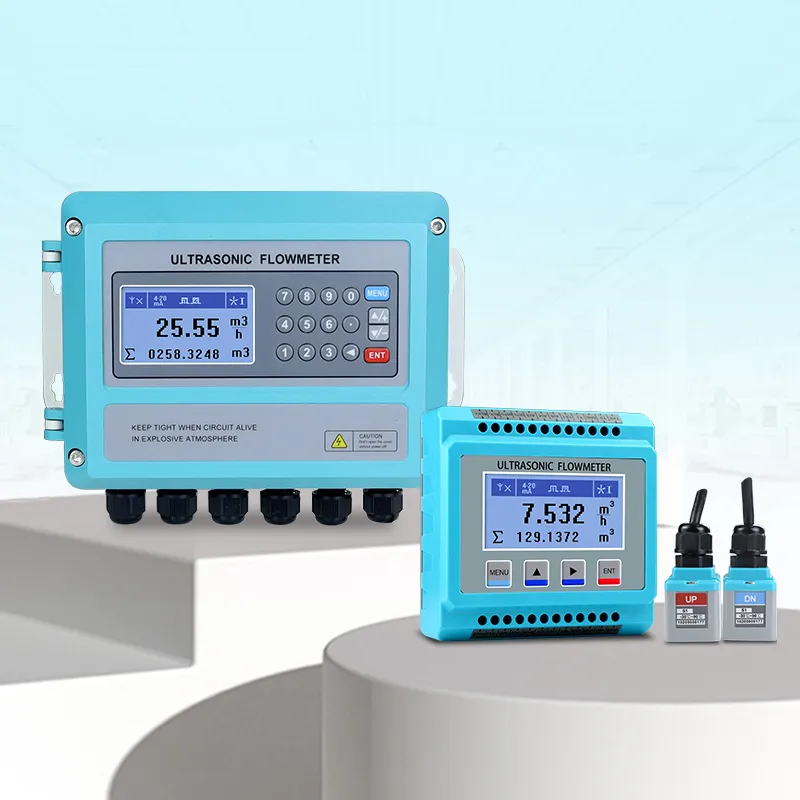
What Are the Main Applications of Ultrasonic Flow Meter Technology?
The main application of ultrasonic flow meter technology is measuring liquid flow in systems where reliable monitoring, minimal process disruption and flexible installation are important.
Common applications include:
Industry | Typical application | Main benefit |
|---|
Water supply | Monitoring distribution pipelines and water consumption | Supports flow monitoring without cutting pipes |
Wastewater treatment | Measuring flow in suitable wastewater pipelines | Helps operators track treatment processes |
HVAC systems | Monitoring chilled water and hot water circulation | Supports system balancing and energy management |
Industrial manufacturing | Measuring process water and compatible liquids | Helps improve process control |
Agriculture | Monitoring irrigation water delivery | Supports water-use management |
In wastewater applications, ultrasonic measurement can also support flow estimation in open channels when combined with suitable level-measurement methods and channel geometry. Research published by IWA Publishing discusses wastewater flow-rate estimation using ultrasonic water-level measurement, illustrating how ultrasonic technology can contribute to wastewater monitoring. See the wastewater flow-rate estimation study for further technical context.
For field inspections or temporary measurement tasks, a portable ultrasonic flow meter for water can help technicians check flow at different points without permanently installing a meter at every location.
Which Ultrasonic Flow Meter Type Fits Your Application?
The right meter type depends on the liquid condition, pipe material, installation environment and whether measurements must be permanent or temporary.
Meter type | Typical use | Key consideration |
|---|
Clamp-on | Existing pipelines and non-invasive measurement | Requires suitable pipe and acoustic conditions |
Inline | Permanent installation in a dedicated pipeline | May require pipe modification and planned shutdown |
Portable | Field checks, troubleshooting and temporary surveys | Battery life and setup time affect field use |
Doppler | Liquids containing suspended solids or bubbles | Performance depends on sufficient acoustic reflectors |
Clamp-on and portable models are useful when cutting the pipeline is impractical. Inline meters may be appropriate for dedicated systems where permanent installation is acceptable. Doppler meters should not automatically be selected for clean water, as their operation depends on particles or bubbles reflecting ultrasonic signals.
Buyers comparing available configurations can review JUJEA's ultrasonic flow meter types to understand how measurement principles and operating conditions influence instrument selection.
How Can You Improve Ultrasonic Flow Measurement Accuracy?
Ultrasonic flow measurement accuracy depends on installation quality, pipe conditions and the properties of the liquid. Even a suitable meter can produce unreliable readings if the signal is weak or the installation does not follow the manufacturer's instructions.
Important factors include:
Pipe condition: Rust, scale, lining and deposits can affect acoustic transmission.
Installation location: Elbows, valves and pumps may create disturbed flow. Follow the manufacturer's recommendations for straight pipe lengths and transducer positioning.
Liquid properties: Bubbles, suspended solids and changes in liquid composition can affect signal quality, depending on the measurement method.
Sensor mounting: Correct spacing, alignment and adequate acoustic coupling are essential for clamp-on devices.
Configuration: Enter the correct pipe diameter, wall thickness, material and other required parameters.
The ISO 24062 standard provides requirements for clamp-on ultrasonic transit-time flow meters used for liquid flow measurement in closed conduits. Referencing relevant standards alongside the manufacturer's technical documentation can help engineers evaluate equipment suitability and measurement performance.
How Should Buyers Select an Ultrasonic Flow Meter?
Selecting a meter starts with defining the measurement task rather than choosing a model based on price alone. Buyers should confirm the liquid type, flow range, pipe size, pipe material, temperature, pressure and required accuracy.
For permanent monitoring, installation space, output signals and integration with control systems may be important. For maintenance teams, portability, battery operation and ease of setup may matter more. For challenging liquids, the measurement principle must be compatible with the amount of suspended material and the expected signal conditions.
A reliable ultrasonic flow meter application assessment should also consider service access, calibration requirements and the availability of technical support. Reviewing the product specifications and discussing unusual operating conditions with the supplier can reduce the risk of selecting an unsuitable instrument.
Conclusion
Ultrasonic flow meters offer flexible solutions for liquid measurement in water supply, wastewater, HVAC, manufacturing and irrigation systems. Choosing the right type requires matching the measurement principle to the liquid, pipe conditions and installation requirements. With proper installation and configuration, ultrasonic technology can provide useful flow data while minimizing disruption to existing pipelines. JUJEA offers ultrasonic flow measurement options for different liquid monitoring needs, helping buyers compare configurations according to their application.
FAQs
What is the main application of an ultrasonic flow meter?
Its main application is measuring liquid flow in pipelines, including water distribution, wastewater treatment, HVAC circulation and industrial processes.
Can an ultrasonic flow meter measure water without cutting the pipe?
Yes. A compatible clamp-on model can measure flow from outside the pipe, provided the pipe material, condition and liquid allow reliable ultrasonic transmission.
Are ultrasonic flow meters suitable for wastewater?
They can be suitable, depending on the wastewater characteristics and meter type. Suspended solids, bubbles and changing flow conditions should be considered during selection.
What is the difference between transit-time and Doppler ultrasonic flow meters?
Transit-time meters compare the travel time of ultrasonic signals and are commonly used for cleaner liquids. Doppler meters detect frequency shifts from particles or bubbles moving in the liquid.
How can I improve ultrasonic flow meter accuracy?
Use the correct measurement principle, install transducers according to the manufacturer's guidance, enter accurate pipe parameters and check signal quality during commissioning.
How do I choose a portable ultrasonic flow meter for water?
Check the pipe-size range, compatible pipe materials, liquid conditions, measurement range, battery life, data output and accuracy specifications against your field measurement requirements.
Ethan Liu
Ethan Liu is JUJEA's technical content specialist, translating complex sensor integration and industrial automation concepts into practical insights for engineers, system integrators, procurement professionals, and decision-makers worldwide.


 한국어
한국어 français
 Deutsch
 Español
 italiano
 русский
 português
 العربية
 tiếng việt
 čeština