The difference between pressure gauge and pressure transmitter mainly comes down to how pressure is displayed, transmitted and integrated into a control system. A pressure gauge is primarily used for local visual pressure indication, while a pressure transmitter converts pressure into an electrical signal for remote monitoring, recording or automatic control. Understanding this distinction helps engineers select the right instrument for water systems, hydraulics, chemical processing, gas systems and industrial automation.
What Is the Difference Between a Pressure Gauge and a Pressure Transmitter?
A pressure gauge provides a local indication of pressure, whereas a pressure transmitter measures pressure and converts it into an electrical output for remote monitoring or process control.
A traditional mechanical gauge responds to pressure through a sensing element such as a Bourdon tube or diaphragm and displays the result on a dial. An electronic or digital gauge uses a pressure sensor and displays the measured value numerically.
A pressure transmitter combines a pressure-sensitive element with signal-conditioning electronics. It converts the measured pressure into an electrical output, commonly allowing the signal to be sent to a PLC, DCS, data logger or other control system.
The distinction is therefore not simply mechanical versus electronic. The key difference is the measurement interface and intended use: a gauge is optimized for direct local observation, while a transmitter is designed for remote measurement and system integration.
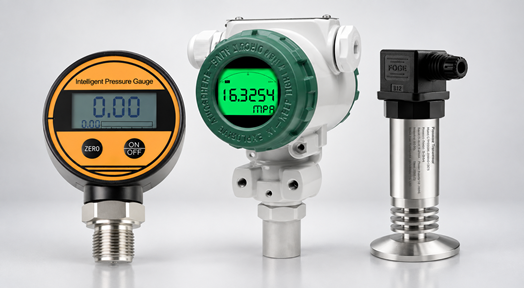
How Do Pressure Gauges and Pressure Transmitters Compare?
Pressure gauges and pressure transmitters can measure the same physical variable, but their outputs, installation requirements and roles within an instrumentation system are different.
Pressure gauge: Provides direct local indication and is suitable when operators need to observe pressure at the equipment. JUJEA's range of industrial pressure gauges can be considered for applications requiring local pressure indication.
Pressure transmitter: Converts pressure into an electrical signal for remote monitoring, control and data acquisition. It is better suited to automated systems where pressure values need to be continuously transmitted to a control platform.
| Factor | Pressure Gauge | Pressure Transmitter |
|---|
| Primary purpose | Local pressure indication | Remote measurement and control |
| Display | Dial or local digital display | Usually external display or control system |
| Output | Often none | Electrical or digital output |
| Automation | Limited | Designed for system integration |
| Installation | Usually straightforward local mounting | Requires process connection and electrical wiring |
| Typical use | Local equipment inspection | Continuous process monitoring |
| Power | Mechanical models need no power | Electronic models normally require power |
The choice therefore depends on whether pressure is primarily something an operator needs to see or a process needs to measure, transmit and act upon.
When Should You Use a Pressure Gauge or Pressure Transmitter?
The choice between a gauge and transmitter depends on whether the application requires local observation, remote measurement or automatic process control.
A pressure gauge is appropriate when an operator needs to read pressure directly at pumps, compressors, hydraulic equipment, pipelines or other process points. It can provide a simple and independent indication without requiring integration into a control network.
A pressure transmitter becomes more valuable when pressure needs to be monitored from a control room or used as an input for automatic control. Common pressure transmitter applications include water systems, chemical processing, gas systems, hydraulic equipment and industrial automation.
For systems requiring both local visibility and remote data, the two instruments can also work together. A gauge can provide an immediate local reference while a transmitter continuously supplies electronic data to the control system.
Pressure type should also be considered. Gauge, absolute and differential pressure are different measurement references, and the appropriate choice depends on the process. The BIPM's pressure-metrology program specifically covers gauge, differential and absolute pressure.
What Affects Pressure Measurement Accuracy and Reliability?
Pressure measurement accuracy depends on the sensing technology, pressure range, installation conditions, calibration and environmental stability.
The selected pressure range should match the actual operating range. A very large range may reduce useful resolution, while an unsuitable range can expose the instrument to excessive pressure.
Calibration is also important for both gauges and transmitters. NIST maintains pressure standards and calibration services covering electronic pressure instruments, with submitted calibration items measured from 10 kPa to 280 MPa.
For traceable pressure measurement, NIST's information on piston gauges and pressure transducers explains how pressure-sensing devices can be calibrated against piston-gauge standards. This illustrates why calibration is important when pressure measurement is used for critical process decisions.
Installation can also affect performance. Process connection, vibration, pulsation, temperature and the measured medium should be evaluated. Engineers looking for information on how does a pressure transducer work should also consider how the sensing element, signal conditioning and installation environment influence the final measurement.
How Should Buyers Select the Right Pressure Instrument?
The right pressure instrument should be selected according to the measurement objective, pressure type, operating range, environment and required system integration.
Choose a pressure gauge when local visual indication is the primary requirement and no continuous electrical signal is needed.
Choose a pressure transmitter when pressure must be remotely monitored, recorded, alarmed or used as an input for automatic control.
Consider both when operators need local pressure visibility while the control system also requires continuous electronic measurement.
Before specifying a product, confirm the pressure type, measurement range, process connection, medium compatibility, temperature, output signal and environmental conditions. For transmitters, power supply and communication requirements should also be checked.
JUJEA provides pressure measurement solutions for different industrial requirements, allowing users to select an appropriate instrument according to the actual process architecture rather than simply choosing based on instrument type.
Conclusion
The difference between pressure gauge and pressure transmitter is primarily their role in a measurement system. A pressure gauge is designed mainly for local pressure indication, while a pressure transmitter converts pressure into an electrical signal for remote monitoring, automation and process control. Neither instrument is universally suitable for every application. The correct choice depends on whether local reading, remote transmission, automatic control, calibration capability and environmental resistance are required. For industrial projects, evaluating pressure range, pressure type, process connection and output requirements together helps engineers select an instrument that matches the actual measurement system.
FAQ
Can a pressure gauge and pressure transmitter measure the same pressure?
Yes. They can measure the same process pressure, although their outputs and intended functions are different.
Does a pressure transmitter need power?
Most electronic pressure transmitters require electrical power for sensing, signal conditioning and signal transmission.
What is the common output of a pressure transmitter?
4–20 mA is widely used in industrial instrumentation, although other analog and digital communication interfaces are also available.
Are pressure gauges suitable for automatic control?
A conventional gauge is mainly intended for local indication. A transmitter is generally more appropriate when pressure must be used directly as an input for automatic control.
What is the difference between gauge and absolute pressure?
Gauge pressure is referenced to atmospheric pressure, while absolute pressure uses a vacuum or absolute zero-pressure reference.
Should a system use both a gauge and a pressure transmitter?
It can. A gauge can provide local visual indication while a transmitter sends continuous pressure data to a PLC, DCS or monitoring system.
Ethan Liu
Ethan Liu is JUJEA's technical content specialist, translating complex sensor integration and industrial automation concepts into practical insights for engineers, system integrators, procurement professionals, and decision-makers worldwide.


 한국어
한국어 français
 Deutsch
 Español
 italiano
 русский
 português
 العربية
 tiếng việt
 čeština