Introduction
Flow refers to the volume of fluid passing through a given point per unit of time. In water resource measurements, flow is typically quantified in units such as cubic feet per second (cfs), cubic meters per second (cms), gallons per minute (gpm), or other similar units. Accurate flow measurement is critical for applications including system control, billing, and engineering design. This article outlines several common flow measurement methods and provides relevant background information.
Continuity Equation for Flow
Under steady-state conditions (i.e., unchanging over time), the principle of continuity dictates that the water entering one end of a pipe must exit the other end. The continuity equation is expressed as:
Flow = Velocity × Cross-sectional Area
In steady-state conditions, the product of velocity and cross-sectional area remains constant at any point along the pipe. For example, if the velocity is measured at 10 feet per second and the cross-sectional area is 10 square feet, the flow rate would be 10 × 10 = 100 cubic feet per second.
Open Channel Flow Measurement Methods
Visual Estimation Method
This basic approach involves estimating flow by visually assessing velocity and cross-sectional area. A ruler can improve area measurement accuracy, while a stopwatch can time floating debris over a known distance to estimate velocity.
Applications: Low-flow scenarios or rough order-of-magnitude estimates.
Depth-to-Flow Method (Manning’s Equation)
When channel geometry and slope are known and flow is uniform, Manning’s equation calculates flow using depth measurements. The formula relates velocity to depth, slope, and Manning’s roughness coefficient (n).
Note: Not suitable for gradually varied flow (e.g., backwater upstream of dams). The U.S. Geological Survey (USGS) often employs this method, using hydraulic models to establish stage-discharge relationships.
Primary Measurement Devices
Structures like flumes or weirs force flow through critical depth, creating a one-to-one relationship between depth and flow.
Advantages: Non-contact measurement, high reliability.
Disadvantages: Potential head loss. Considered the most accurate open-channel method.
Area-Velocity Meters (AV Meters)
These measure depth (converted to area) and velocity (via Doppler ultrasound or optical surface tracking) to compute flow using the continuity equation. Common brands include ISCO, ADS, and Hach (Sigma and Marsh-McBirney meters).
Applications: Short-term sewer monitoring.
Drawbacks: Requires sensor immersion, frequent maintenance, and offers lower accuracy than primary devices.
Transit-Time Flow Meters
Developed for large pipes in the petroleum industry, these use ultrasonic wave transit times between sensors to calculate velocity.
Advantages: High precision through cross-sectional velocity profiling.
Disadvantages: Higher cost due to complex installation.
Full-Pipe Flow Measurement Methods
Venturi Meters
Utilize the Venturi effect—constricting flow to create a pressure drop for measurement via Bernoulli’s principle.
Applications: Clean water; wastewater risks clogging pressure ports.
Turbine Flow Meters
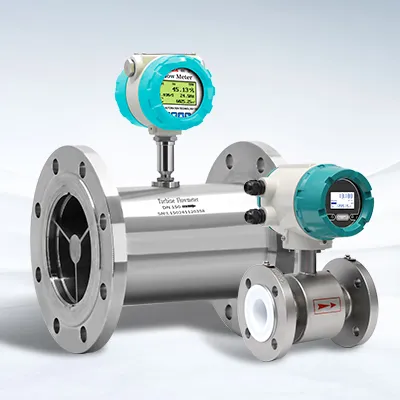
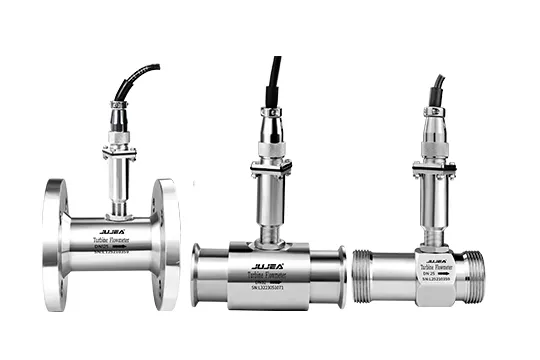
Mechanical devices measuring flow via turbine rotation speed.
Limitations: Suitable only for clean water; solids in wastewater may jam the turbine.
Magnetic Flow Meters
Operate on Faraday’s law of induction, detecting voltage induced by fluid movement through a magnetic field.
Advantages: No added head loss; now available for open-channel use.
Conclusion
Each method has unique advantages, limitations, and accuracy levels. Selecting the appropriate technique depends on specific application requirements. Cloud-based analytics tools can enhance data processing and performance evaluation for flow meters.
Ethan Liu
Ethan Liu is JUJEA's technical content specialist, translating complex sensor integration and industrial automation concepts into practical insights for engineers, system integrators, procurement professionals, and decision-makers worldwide.


 한국어
한국어 français
 Deutsch
 Español
 italiano
 русский
 português
 العربية
 tiếng việt
 čeština