Anhui Jujie Automation Technology Co., LTD.

Conductivity Measurement Instruments for High-Precision Industrial Liquid Quality Monitoring

Our integrated conductivity monitoring system consists of transmitters and matched electrodes. It measures EC with ±0.5% full-scale accuracy, supporting auto temperature compensation, 4-20mA and RS485 Modbus outputs for water treatment, power and chemical online water quality monitoring.

Types of Conductivity Measurements

Conductivity Sensors
This series of conductive electrodes adopts durable graphite or stainless steel probes with multiple cell constant options. Built-in temperature sensors support automatic compensation, resisting sludge adhesion, matching model 480 transmitters for measuring EC, TDS and salinity in water treatment.
Conductivity Transmitters
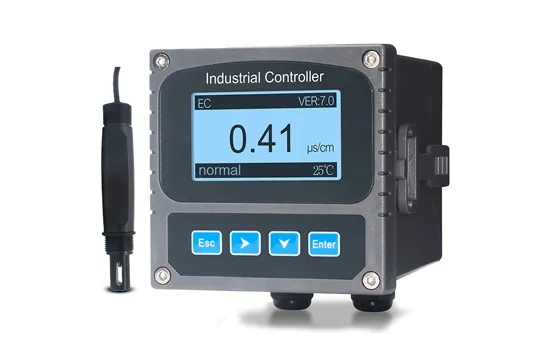
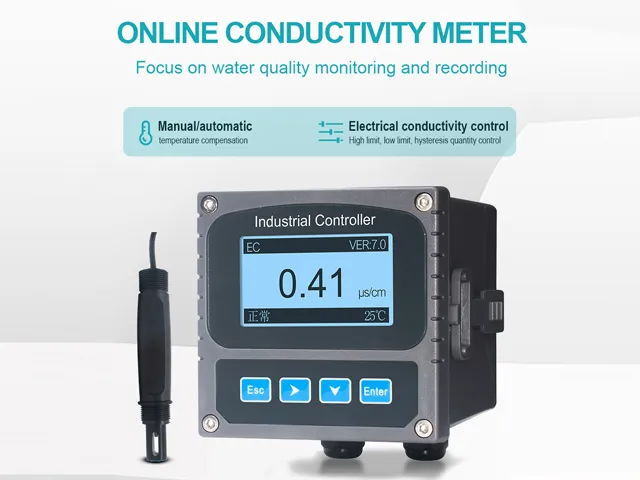
Digital wall-mounted conductivity transmitter pairs with 2900 sensors, featuring clear LCD display and one-point calibration. It outputs 4-20mA and RS485 signals with relay alarms, used for real-time monitoring of water conductivity in chemical, power and sewage industries.

Conductivity Measurement Instruments Improve Efficiency in Water Treatment Processes

Automatic Chemical Dosing Control

Real-time conductivity data connects with dosing pumps to adjust reagent volume intelligently, avoiding excessive chemical use and lowering operating costs steadily.

Built-In Temperature Compensation

It automatically offsets temperature interference to maintain stable readings, cutting frequent manual sampling and laboratory testing labor costs.

Anti-Fouling Long-Life Electrodes

Sludge-resistant probe materials extend cleaning cycles, reducing equipment disassembly downtime and keeping water treatment running continuously.

Remote Digital Signal Transmission

4-20mA and RS485 signals upload data to PLC or cloud, supporting centralized remote monitoring to realize unmanned workshop management.

What Challenges Can Conductivity Measurement Instruments Solve in Process Industries?

  • Unstable Water Ion Concentration Control

    They continuously detect conductivity to reflect dissolved solids, automatically adjusting chemical dosing. This solves unstable water quality caused by manual dosing errors in chemical, power and water treatment processes.

  • Temperature-Induced Measurement Inaccuracy

    Liquid temperature changes skew conductivity readings. Built-in automatic temperature compensation eliminates such deviations, removing the trouble of repeated manual correction for field operators.

  • Late Detection of Equipment Leakage or Filter Failure

    Over-limit conductivity triggers relay alarms instantly. It timely finds pipeline leakage, broken filters and reverse osmosis membrane damage, preventing massive unqualified wastewater outflow.

  • High Labor Cost from Manual Sampling Inspection

    Digital real-time monitoring replaces frequent lab sampling. With 4-20mA and RS485 output, data uploads to control systems, cutting heavy routine testing labor for large-scale factories.

  • Frequent Sensor Clogging and Short Service Life

    Graphite and stainless steel anti-fouling electrodes reduce sludge adhesion. Longer cleaning intervals solve frequent disassembly maintenance that interrupts continuous industrial production.

  • Difficult Unified Remote Monitoring of Multi-site Workshops

    Modbus RS485 communication connects multiple meters to central PLC. It breaks the limitation of on-site manual patrol, solving the difficulty of centralized management of distributed production lines.

What Challenges Can Conductivity Measurement Instruments Solve in Process Industries?
We use cookies to offer you a better browsing experience, analyze site traffic and personalize content. Part of the tracking is necessary to ensure SEO effectiveness,
By using this site, you agree to our use of cookies. Visit our cookie policy to learn more.
Reject Accept