The working principle of thermal mass flow meter is based on heat transfer between a heated sensing element and flowing gas. As gas passes the sensor, it carries heat away from the heated element. The resulting thermal change is detected and converted into a mass flow signal. This makes thermal mass flow meters useful for industrial gases where direct mass-flow information is required.
For engineers and purchasing teams, understanding this principle helps determine whether thermal mass measurement is suitable for compressed air, natural gas and other process gases.
What Is the Working Principle of a Thermal Mass Flow Meter?
The working principle of a thermal mass flow meter is the measurement of gas flow by detecting how flowing gas changes heat transfer around a heated sensor.
A typical meter uses a heater together with temperature-sensing elements. When gas passes through the sensing area, it removes thermal energy from the heater. Increasing mass flow changes the amount of heat transferred, producing a measurable temperature difference or changing the power required to maintain a controlled temperature.
In one design, the heater operates at constant power and the instrument measures the temperature difference. In another, the electronics maintain a constant temperature difference and calculate the required heating power. Both approaches connect the thermal response with the mass of gas passing the sensor.
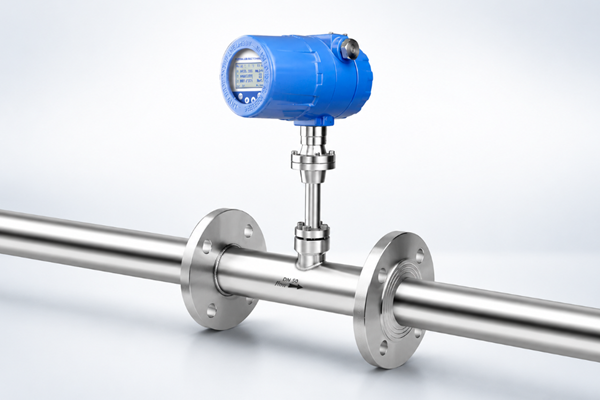
How Does Thermal Mass Flow Measurement Work?
Thermal mass flow measurement works by converting the thermal response of the sensing element into a calibrated flow value.
When gas flow is low, relatively little heat is carried away. As flow increases, more thermal energy is transferred to the gas. The transmitter processes this change and calculates the corresponding mass flow.
Gas properties also affect the measurement. Heat capacity, thermal conductivity, density and gas composition influence the sensor response. Therefore, calibration for the actual gas and operating conditions is important.
This is particularly relevant when selecting a thermal mass flow meter for natural gas. Natural gas composition can vary, so calibration conditions should be considered during specification. NIST's gas-flow standards for calibration and measurement provide useful reference information on traceability and uncertainty in gas-flow measurement.
For larger pipelines, an insertion type thermal mass flow meter can be practical because its sensing probe is installed directly into an existing pipe.
Thermal Mass Flow Meter for Natural Gas vs. Compressed Air
A thermal mass flow meter for natural gas and one for compressed air use the same basic heat-transfer principle, but their application conditions can differ.
| Factor | Natural Gas | Compressed Air |
|---|
| Main application | Fuel and process gas | Plant utility and pneumatic systems |
| Key consideration | Gas composition | Pressure and moisture |
| Main concern | Calibration conditions | Flow range and installation |
| Typical use | Process monitoring | Consumption monitoring |
For a thermal mass flow meter for compressed air, buyers should consider minimum and maximum flow, operating pressure, pipe size, moisture conditions and output requirements. Such meters can support consumption monitoring across plant headers, production lines and individual machines.
Natural-gas applications require additional attention to gas composition and reference conditions, especially where flow data is used for process control or commercial measurement.
What Affects Thermal Mass Flow Meter Accuracy?
Thermal mass flow meter accuracy is affected by gas properties, calibration, installation and operating conditions.
A meter calibrated under laboratory conditions may perform differently if the actual gas composition, pressure, temperature or flow profile changes significantly. Installation can also affect measurement. Elbows, valves, reducers and other disturbances near the sensor may alter the velocity profile and thermal response.
The final measurement uncertainty therefore depends on more than sensor electronics. Calibration equipment, reference standards and environmental conditions also contribute. The thermal mass gas flowmeter calibration requirements defined by ISO 14511 provide a useful framework for considering these factors.
For industrial projects, buyers should review the calibrated gas, flow range, reference conditions, pressure and temperature limits, sensor configuration and required output rather than relying only on a headline accuracy value.
How Should Buyers Select a Thermal Mass Flow Meter?
Selecting a thermal mass flow meter requires matching the instrument to the actual gas and operating environment.
The main factors include:
Gas type and composition: Confirm the gas being measured.
Flow range: Define minimum, normal and maximum flow.
Pressure and temperature: Check the full operating range.
Installation: Determine whether inline or insertion installation is appropriate.
Output: Confirm requirements such as 4–20 mA, pulse or digital communication.
Calibration: Check the calibration gas and reference conditions.
JUJEA provides thermal gas flow measurement solutions for industrial applications. Complete application information allows engineers to select a suitable configuration and reduce measurement problems caused by mismatched operating conditions.
Conclusion
The working principle of thermal mass flow meter is based on measuring the heat transferred between a heated sensing element and flowing gas. The thermal response is processed by the instrument and converted into a mass-flow reading. This makes the technology useful for compressed air, natural gas and other industrial gas applications.
However, selecting a suitable meter requires more than checking the nominal flow range. Gas composition, calibration conditions, pressure, temperature, installation and output requirements can all affect measurement performance. For industrial users, evaluating these factors together provides a more reliable basis for instrument selection. JUJEA's thermal gas flow measurement solutions can be specified according to the actual application and operating environment.
FAQ
1. What is the working principle of a thermal mass flow meter?
It measures gas flow by detecting how flowing gas transfers heat away from a heated sensing element and converting the thermal response into a mass-flow signal.
2. What gases can a thermal mass flow meter measure?
It can measure many industrial gases, including air, natural gas, nitrogen and other gases with suitable calibration or compensation data.
3. Why does gas composition affect thermal mass measurement?
Different gases have different thermal properties, which influence heat transfer and sensor response. Appropriate calibration is therefore important.
4. Is a thermal mass flow meter suitable for compressed air?
Yes. It is suitable for many compressed-air monitoring applications when flow, pressure, temperature and installation conditions match the instrument specifications.
5. What is an insertion type thermal mass flow meter?
It uses a probe inserted into an existing pipeline to measure gas flow and can be practical for larger pipes and ducts.
6. What should buyers check before selecting one?
Check gas type, flow range, pressure, temperature, pipe size, installation conditions, calibration basis, accuracy and output requirements.
Ethan Liu
Ethan Liu is JUJEA's technical content specialist, translating complex sensor integration and industrial automation concepts into practical insights for engineers, system integrators, procurement professionals, and decision-makers worldwide.


 한국어
한국어 français
 Deutsch
 Español
 italiano
 русский
 português
 العربية
 tiếng việt
 čeština