Industrial oxygen flow measurement requires more than accurate gas-flow readings. Oxygen strongly supports combustion, and an oxygen-enriched environment can increase the ignition risk of materials and contaminants that may be less hazardous in ordinary compressed-air systems.
For industrial oxygen pipelines, the selection process must consider oxygen-specific ignition mechanisms, wetted-material compatibility, cleaning requirements, operating pressure, and the flow meter's calibration.
JUJEA offers MF-series thermal flow meters with oxygen calibration options. However, oxygen calibration alone does not establish that every instrument configuration is suitable for a particular oxygen-service pressure, purity, or cleanliness requirement.
Why Does Oxygen Service Require Special Safety Evaluation?
Oxygen is not a fuel, but it supports the combustion of other materials. In an oxygen system, the combination of an ignition mechanism and combustible material can result in rapid combustion or equipment damage.
Three important ignition mechanisms require particular attention.
High surface temperature: Hot components or localized heating may increase the likelihood of ignition when susceptible materials are exposed to oxygen.
Adiabatic compression: Rapid pressurization can cause a substantial local temperature rise, particularly in dead-ended sections or equipment exposed to sudden pressure changes.
Particle impact: Metallic or nonmetallic particles carried by high-velocity oxygen may strike internal surfaces, generating localized heat and potentially initiating ignition.
These mechanisms should be evaluated together with the oxygen concentration, pressure, temperature, flow velocity, materials, and instrument geometry.
A generic gas meter should not be transferred into oxygen service simply because its measuring range is suitable.
Which Wetted Materials Must Be Verified for Oxygen Compatibility?
Oxygen compatibility depends on the complete instrument assembly, including the measuring body, sensing elements, seals, gaskets, adhesives, lubricants, and process connections.
Stainless steel construction does not automatically establish suitability for every oxygen pressure or temperature.
Anodized aluminum, stainless steel, and nonmetallic sealing materials can have different oxygen-service limitations depending on their design and operating conditions.
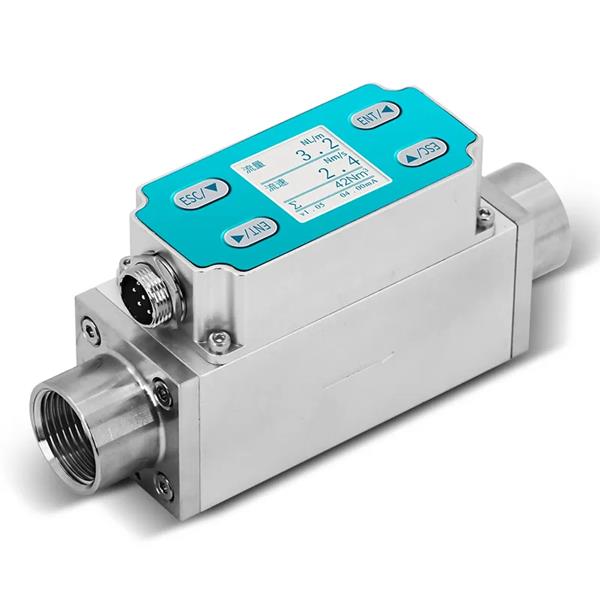
For example, JUJEA lists stainless steel construction for some oxygen flow meter configurations and anodized aluminum or stainless steel options for certain MF-series instruments. These published material descriptions do not replace an oxygen compatibility assessment.
| Component | Oxygen-Specific Selection Requirement |
|---|
| Measuring body | Confirm exact alloy, pressure rating, and oxygen compatibility |
| Sensor and internal parts | Check materials exposed to oxygen and possible localized heating |
| Seals and gaskets | Evaluate oxygen compatibility at the specified pressure and temperature |
| Internal flow passages | Assess particle impact, restrictions, and contamination accumulation |
| Connections | Review sealing method, cleanliness, and pressure requirements |
| Assembly materials | Confirm acceptable lubricants, adhesives, and residual contamination |
| Documentation | Obtain written approval for the intended oxygen-service conditions |
A manufacturer should provide the relevant wetted-material information and confirm the suitability of the selected configuration.
What Cleaning and Degreasing Requirements Apply to Oxygen Flow Meters?
Oxygen-service cleaning is more specific than ordinary instrument cleaning.
Oil, grease, organic residues, metallic particles, and other contaminants may contribute to ignition in oxygen systems. Equipment must therefore be cleaned to a cleanliness level appropriate for its operating conditions.
Relevant guidance includes ASTM G93/G93M, CGA G-4.1, and EIGA Doc 33, which address cleaning methods, cleanliness assessment, and oxygen-service practices.
These references do not automatically establish one universal cleanliness limit for every application. The project specification should define the applicable standard and acceptance criteria.
When evaluating a wall mounted oxygen flow meter or another oxygen instrument configuration, buyers should confirm:
Which components have undergone oxygen-service cleaning.
The cleaning standard and acceptance criteria used.
Whether cleanliness inspection and documentation are available.
How the instrument is protected from contamination after cleaning.
Whether supplied connections and accessories are included in the cleaning scope.
Cleaning, inspection, packaging, and installation handling should follow approved oxygen-service procedures.
Oxygen calibration must not be confused with oxygen cleaning certification. They address different technical requirements.
What Technical Specifications Does JUJEA Provide?
JUJEA's oxygen flow meter product page lists several MF-series thermal gas mass flow meters. The available ranges and operating limits differ by model.
The following specifications are reproduced and summarized from JUJEA's published product information.
| Technical Parameter | MF30 | MF50 | MF52 |
|---|
| Measuring principle | Thermal gas mass flow | Thermal gas mass flow | Thermal gas mass flow |
| Power supply | DC24V/2.5W | DC24V/2.5W | DC24V/2.5W |
| Published accuracy | ±(2.0+0.2FS) | ±(1.5FS) | ±(1.0FS)% |
| Medium temperature | -10~55℃ | -10~55℃ | -10~55℃ |
| Working pressure | ≤1.0MPa (pressure can be customized) | ≤1.0MPa (pressure can be customized), integrated type with pressure measurement display can be customized | ≤1.5MPa (3MPa can be customized) |
| Output | 4–20 mA / RS485 optional | 4–20 mA | 4-20mA or 1~5V, 0-5V / 0-10V is optional |
| Response time | 50–1000 ms | 50–1000 ms | 50 ms |
| Mechanical connection | G3/4 male thread, G1/2 male thread, G3/4 male thread | BSPT female thread and G female thread are optional, see mechanical interface connection dimensions for details | PT1/2 or G1/4 female thread, other thread interfaces can be customized |
| Additional information | 2.8–1000 NL/min published measurable limits | Instantaneous and cumulative flow display | 1:100 range ratio; IP40; DN8/DN15 optional |
The accuracy expressions above retain the manufacturer's published notation. Their mathematical definitions and calibration conditions should be confirmed before quoting a guaranteed accuracy.
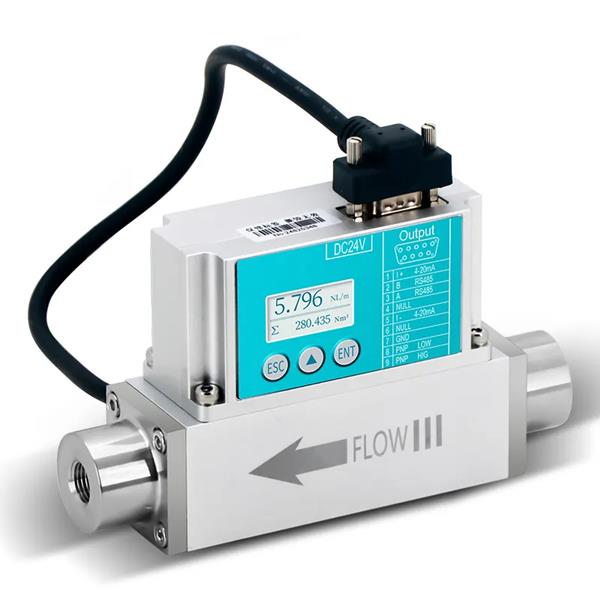
For smaller flow-control applications, JUJEA also lists the MF60 series, including flow specifications expressed in SCCM and SLM, a 24 V DC / 12 W power supply, a published measurement response time below 50 ms, and a 1:100 turndown ratio.
However, the MF60's flow control function and operating pressure requirements differ from those of a simple monitoring instrument.
The low flow meter oxygen configuration should therefore be selected using the required oxygen flow range, calibration conditions, and operating pressure rather than model name alone.
For any MF-series model, buyers must obtain confirmation that the supplied version is compatible with the intended oxygen service.
How Should Oxygen Flow Range and Reference Conditions Be Specified?
Industrial oxygen monitoring may involve low-flow supply lines, process-gas distribution, or larger pipeline measurement.
The minimum and maximum flow must match the selected model's actual measuring range.
The flow units must also be defined clearly. Values expressed in NL/min, SCCM, SLM, or Nm³/h rely on reference conditions that may differ between instruments and suppliers.
JUJEA lists configurable standard-temperature conditions for certain MF-series models, including 0°C, 20°C, and 25°C.
The specified gas flow rate unit should therefore be accompanied by its applicable reference temperature and pressure.
Buyers should also check pressure loss, operating pressure, response time, and whether instantaneous flow, accumulated flow, or flow control is required.
These measurement considerations do not replace the oxygen-service material and cleanliness review.
What Must JUJEA Confirm Before an Oxygen Flow Meter Is Approved?
JUJEA identifies oxygen calibration as a feature of its MF-series oxygen flow meters.
Before approving an instrument, purchasing engineers should request model-specific confirmation covering oxygen concentration, flow range, working pressure, temperature, wetted materials, cleanliness requirements, and pressure-change conditions.
When evaluating a gas flow meter manufacturer for oxygen service, the inquiry should distinguish three separate requirements:
Measurement suitability: Can the selected model measure the required oxygen flow accurately under the specified conditions?
Material and design suitability: Have the wetted materials and instrument geometry been assessed for the intended oxygen concentration, pressure, and temperature?
Cleaning and documentation: Can the supplier provide the required oxygen-cleaning evidence, inspection records, and handling instructions?
JUJEA should confirm these points for the exact ordered configuration. A general product listing or oxygen calibration statement is not sufficient evidence of full oxygen-service approval.
Conclusion
Industrial oxygen flow meter selection requires a dedicated assessment of ignition risks, wetted materials, cleanliness, and instrument performance. High surface temperatures, adiabatic compression, and particle impact are important mechanisms that distinguish oxygen systems from ordinary gas installations. JUJEA provides several MF-series thermal flow meter configurations with published measurement specifications and oxygen calibration options. However, those specifications do not establish universal oxygen-service suitability or cleaning certification. Buyers should provide complete operating conditions, request manufacturer confirmation, and verify the applicable cleaning and material requirements before approving an instrument for oxygen service.
Frequently Asked Questions
Can an air-calibrated flow meter be used directly for oxygen?
Not without manufacturer confirmation of oxygen calibration, material compatibility, and the intended oxygen-service conditions.
Does an oxygen calibration statement prove the instrument is oxygen-clean?
No. Calibration and oxygen-service cleanliness are separate requirements.
Why can rapid pressurization be hazardous in oxygen systems?
Rapid compression can produce localized heating and may contribute to ignition under susceptible conditions.
Are all MF-series instruments suitable for the same oxygen pressure?
No. Published pressure limits and available configurations differ by model.
What reference conditions should be stated for oxygen flow measurements?
Specify the standard temperature and pressure associated with the chosen normalized or standard flow unit.
What should be included in an oxygen flow meter purchase specification?
Include oxygen purity, flow range, pressure, temperature, connections, wetted materials, cleaning requirements, calibration conditions, and required documentation.
Ethan Liu
Ethan Liu is JUJEA's technical content specialist, translating complex sensor integration and industrial automation concepts into practical insights for engineers, system integrators, procurement professionals, and decision-makers worldwide.


 한국어
 français
 Deutsch
 Español
 italiano
 русский
 português
 العربية
 tiếng việt
 čeština