Industrial pipelines do not always carry liquid in one direction. Pump switching, tank filling and emptying, recirculation, and pressure changes can create periods of reverse flow.
When a monitoring arrangement records only forward movement, these events may be overlooked. This can distort production totals, water balances, or transfer records.
Bidirectional flow measurement allows operators to distinguish liquid moving in the designated forward direction from liquid moving in reverse. The key requirements are correct direction identification, separate accumulation where supported, suitable alarm functions, and installation conditions that remain appropriate in both directions.
Why Does Reverse Flow Occur in Industrial Pipelines?
Reverse flow can occur during normal operation or as an unintended process event.
For example, a storage tank may receive liquid through a pipeline during filling and discharge liquid through the same line during emptying.
Recirculation systems may experience direction changes when pumps or valves switch operating modes.
In pumping systems, pressure differences can also cause backflow when a pump stops or when a non-return valve fails to close properly.
Not every reverse-flow event is abnormal. Some processes intentionally use two-way liquid transfer.
The first task is to define which flow direction is considered positive, when negative flow is expected, and whether reverse movement should be recorded, restricted, or investigated.
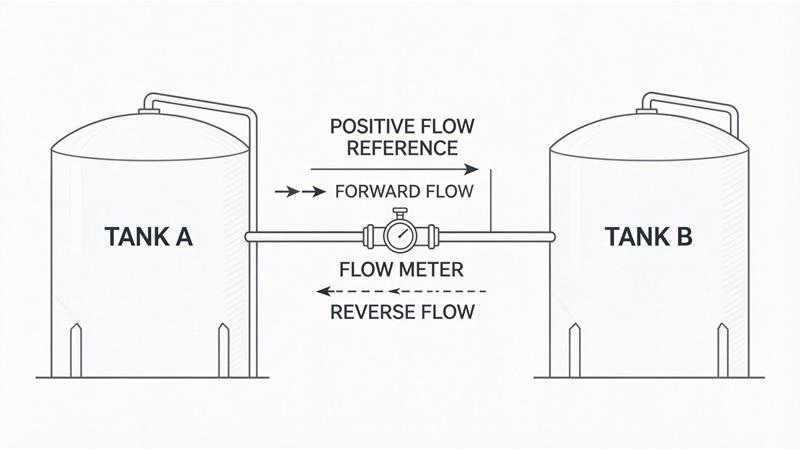
How Does a Meter Identify Forward and Reverse Flow?
A bidirectional meter determines the direction of measured liquid movement relative to its configured reference direction.
For example, a pipeline instrument may display positive instantaneous flow when liquid moves in the designated direction and a negative value when flow reverses.
An important distinction is that the sign of the reading depends on the instrument's orientation and configuration.
During commissioning, engineers should verify the actual process flow direction against the meter's direction indicator and configured positive-flow reference.
A negative reading may represent genuine reverse flow, but it can also result from incorrect installation or configuration.
For an electromagnetic flow meter application involving conductive liquids, buyers should confirm that the selected converter supports the required directional display and accumulation functions.
JUJEA's conductive liquid flow meter specifically identifies bidirectional measurement as a supported feature. The actual display and totalizer functions should be checked against the selected converter configuration.
Forward, Reverse and Net Flow: What Should Be Recorded?
Separate totalizers provide greater operational clarity than a single net volume figure.
A forward totalizer records accumulated flow in the designated positive direction, while a reverse totalizer records accumulated movement in the opposite direction.
Net flow represents the difference between the two quantities when the system uses a signed convention.
| Measurement Function | Purpose | Typical Use |
|---|
| Forward flow rate | Monitor positive-direction movement | Normal transfer monitoring |
| Reverse flow rate | Identify opposite-direction movement | Backflow observation |
| Forward accumulated volume | Record total forward transfer | Supply accounting |
| Reverse accumulated volume | Record total reverse transfer | Return-flow accounting |
| Net accumulated volume | Show signed volume balance | Tank transfer analysis |
| Reverse-flow alarm | Signal an unexpected direction | Process exception monitoring |
For example, a pipeline might move 100 m³ forward and 20 m³ backward during a reporting period. Forward and reverse totals remain 100 m³ and 20 m³, while net movement is 80 m³.
A single net value would not fully describe the operating history.
This distinction is especially useful in industrial flow measurement projects involving shared filling and discharge pipelines.
The purchasing specification should identify whether forward, reverse, and net totals must be stored separately. These functions should be verified during commissioning rather than assumed from the term "bidirectional."
When Is a Reverse-Flow Alarm Necessary?
Reverse-flow alarms are useful when liquid should normally move in only one direction.
An alarm may prompt operators to investigate unexpected pressure differences, valve behavior, or pump shutdown conditions.
However, an alarm should not be configured simply because any negative flow is detected.
Brief flow disturbances, measurement noise, and normal operating transitions may create unwanted indications. The required alarm threshold and delay should reflect the actual process.
If reverse flow is part of normal tank operation, recording it may be more important than generating an alarm every time the direction changes.
For applications where backflow could create a process hazard, the meter alarm must not replace the required independent mechanical or safety protection.
JUJEA's conductive liquid flow meter supports bidirectional measurement, but the availability of a dedicated reverse-flow alarm and its configurable conditions must be confirmed for the selected converter.
What Should Engineers Check Before Installation?
The meter should be installed where the pipeline remains full during both forward and reverse operation.
Engineers should check upstream and downstream disturbances in both flow directions because the relevant approach and exit conditions can change when flow reverses.
Air accumulation, partially filled pipes, deposits, and inadequate grounding may affect measurement quality.
For example, JUJEA's Conductive Liquid Flow Meter provides the following published technical specifications for compatible conductive-liquid applications.
| Technical Parameter | JUJEA Conductive Liquid Flow Meter Specification |
|---|
| Nominal diameter | Pipe type with PTFE lining: DN10 ~ DN500; Pipe type with rubber lining: DN65 ~ DN1200 |
| Accuracy class | Class 0.5; Class 1.0 |
| Medium temperature | Ordinary rubber lining: -20 ~ +70℃; PTFE lining: -20 ~ +120℃ |
| Pressure class | 0.6MPa, 1.0MPa, 1.6MPa, 4.0MPa (higher pressure can be customized) |
| Flow measurement range | The flow measurement range corresponds to a flow velocity range of 0.5~5m/s |
| Minimum fluid conductivity | ≥50 µS/cm |
| Signal output | Pulse, 4–20 mA, RS485 |
| Digital frequency output | The frequency can be set within 1-5000Hz, the maximum collector current is 250mA when the external power supply ≤35V is turned on |
| Power supply | 220V, DC24V; Battery power supply |
| Connection method | Flange, thread, clamp |
| Explosion-proof marking | Ex db mb IIC T6 Gb |
| Ambient temperature | -25℃ ~ +60℃ |
| Ambient humidity | 5~95% RH |
| Total power consumption | < 20 W |
Specifications are based on JUJEA's published Conductive Liquid Flow Meter specifications. Available configurations, operating limits, and explosion-proof certification applicability must be confirmed for the selected model.
For bidirectional pipeline applications, engineers should verify that the flow velocity remains within the specified measuring range during both forward and reverse operation.
The selected converter must also support the required directional measurement, forward and reverse totalization, and alarm functions. These functions should not be assumed solely from the general technical specifications.
JUJEA Solutions for Bidirectional Liquid Monitoring
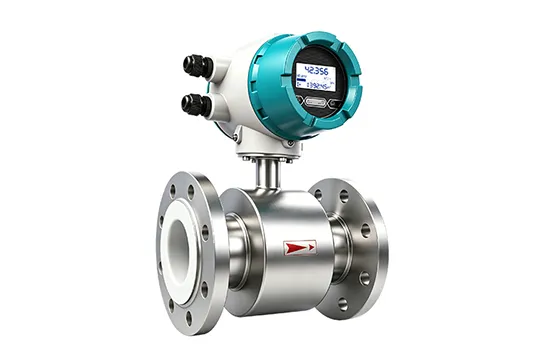
JUJEA offers electromagnetic flow meters for compatible conductive liquids, including its Conductive Liquid Flow Meter.
The product page specifically identifies bidirectional measurement support and lists PTFE and rubber lining configurations for different operating conditions.
Its available pipe sizes, accuracy classes, working pressures, and temperature limits allow buyers to evaluate the instrument against the intended application.
However, the published bidirectional measurement feature should not be treated as automatic confirmation of every directional totalizer or alarm function.
When comparing electromagnetic flow meter suppliers, engineers should request the exact converter model and confirm forward and reverse totalization, net-flow recording, and reverse-flow alarm availability.
Provide the pipeline layout, liquid characteristics, expected direction changes, flow ranges, and operating conditions to support model selection.
For applications where reverse flow must be detected and recorded, JUJEA should confirm the required functions before the equipment is ordered.
Conclusion
Bidirectional flow measurement helps industrial operators understand what happens when liquid moves through a pipeline in both directions. Separate forward and reverse totals provide information that a single net value cannot show. Reliable operation also depends on suitable measurement range, liquid conductivity, correct direction configuration, and installation conditions that remain appropriate when flow reverses. JUJEA's Conductive Liquid Flow Meter supports bidirectional measurement for compatible conductive liquids. Engineers should verify the selected model's specifications, directional accumulation, and alarm functions before purchasing and confirm their operation during commissioning.
Frequently Asked Questions
Does a negative flow reading always indicate a problem?
No. It may reflect intentional reverse flow or an installation and configuration issue.
Can forward and reverse volumes be recorded separately?
Yes, when the selected converter supports independent directional accumulation.
Is net flow the same as total transferred volume?
No. Net flow is the signed balance, while gross movement includes both directions.
Can a flow meter prevent reverse flow?
No. It measures flow; physical prevention requires suitable process equipment.
Should every reverse-flow event trigger an alarm?
Not necessarily. Alarm logic should reflect whether reversal is normal or unexpected.
What must be checked during commissioning?
Verify the reference direction, actual flow sign, directional totalizers, and configured alarm behavior.
Ethan Liu
Ethan Liu is JUJEA's technical content specialist, translating complex sensor integration and industrial automation concepts into practical insights for engineers, system integrators, procurement professionals, and decision-makers worldwide.


 한국어
 français
 Deutsch
 Español
 italiano
 русский
 português
 العربية
 tiếng việt
 čeština