Most problems with an electromagnetic flowmeter manufacturer are visible before the first order — in the documents a factory can produce, not in the samples it ships. This checklist is ordered the way evidence should be weighed: the hardest, most binary proof first (certificates, calibration records, market access), then technical fit, then manufacturing control, then service, delivery and documentation. Each check states what to ask for and what a credible answer looks like.
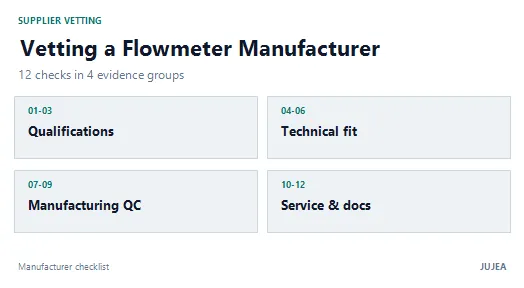
Twelve checks in four evidence groups — compliance, technical fit, manufacturing control, and service, delivery and documentation.
Short answer: a credible electromagnetic flowmeter manufacturer can show four things on request — a factory it owns, wetted-part production it controls, calibration it performs or commissions with traceable records, and certificates whose scope covers the exact product and market. If any one of the four is missing, you are either buying from an intermediary or accepting quality you cannot verify.
What a Wrong Supplier Actually Costs
Three costs justify the time spent on vetting — none of them appears on a quotation:
Unplanned downtime. A meter that fails early stops a line or a process. The replacement unit is usually the smallest part of the loss; production interruption and restart time are larger.
Product or process contamination. A liner or electrode that is wrong for the chemistry can fail early, release material into the process, or force a batch to be scrapped. In food, pharmaceutical or chemical service, the batch is the loss.
Compliance rejection. A meter without the certificate your market or insurer requires can be refused at the border, by the end customer's auditor, or by the safety review before start-up. Recovering from that is slower than choosing correctly.
The 12 Checks at a Glance
# | Check | What to ask for | Credible evidence |
1 | Quality system and scope | ISO 9001/14001/45001 certificates and scope documents | Certificate number verifiable with the issuer; scope and address match the factory |
2 | Market access and hazardous area | CE declaration; MID where billing applies; ATEX/IECEx/NEPSI where flammable media apply | Scheme and certificate number named specifically — not "all certificates available" |
3 | Calibration and accuracy evidence | Rig type, range, uncertainty; in-house vs third-party traceable calibration; accuracy class data | Traceable wet-calibration report; records retrievable by serial number |
4 | Range and material coverage | DN range, liner options, electrode alloys, pressure/temperature limits | Written recommendation against your process data |
5 | Converter and protocol compatibility | HART, Modbus RTU, Profibus/Profinet where used; I/O count; remote configuration | Protocol document or register map; DCS/PLC integration evidence |
6 | OEM/ODM and customisation | Non-standard DN, special liner, private label, manual and display language | Photos or samples of previous private-label work; certification impact stated |
7 | Factory reality | Business licence scope, factory address, live video tour | Production line, assembly and test area; address matches certificates |
8 | Factory testing and sampling | Pressure/insulation test, burn-in, wet calibration, sampling plan | Serial-level test records; sampling rate stated, not implied |
9 | R&D and intellectual property | Engineering team, patents, firmware ownership, custom development cases | Evidence of in-house development, not just assembly |
10 | After-sales and spare parts | Warranty term, response time, remote diagnostics, parts availability | Written terms; named after-sales contact; RMA process |
11 | Lead time and capacity | Quoted lead time vs the last three comparable orders; MOQ; stock policy | Actual delivery records; MOQ in writing |
12 | Export documents and declarations | Certificate of origin, CE and hazardous-area declarations, packing list, invoice | Complete document set your customs and customer will accept |
How to Use the List
Work from hard evidence to soft claims. Checks 1–3 are close to binary: a supplier either has a certificate number and a calibration record, or it does not. If those cannot be produced before the first order, later answers about service and flexibility are worth less.
Checks 4–6 test whether the product can do the job. Checks 7–9 test whether the factory can repeat it. Checks 10–12 decide how the relationship runs after the order is placed.
Group 1 — Qualifications and Compliance (Checks 1–3)
1. Quality system — and the scope behind it
Ask for ISO 9001, ISO 14001 and ISO 45001 certificates as PDFs, then check three things: the certificate number is verifiable with the issuing body, the scope names the product category, and the certified address matches the manufacturing site. ISO 9001 certifies a management system, not the accuracy of a flowmeter — the ISO guidance for supply-chain buyers is explicit about what it does and does not prove.
2. Market access and hazardous area
CE marking, RoHS compliance, MID and explosion protection answer different questions, and buyers routinely conflate them:
CE is a market-access declaration; a CE mark alone does not certify measurement accuracy.
MID (Measuring Instruments Directive) applies to meters used in regulated billing applications in the EU, such as water supply. Ask whether the specific model and application fall within its scope — do not assume CE implies MID.
ATEX, IECEx or NEPSI apply where the installation is in a hazardous area — flammable gas, vapour or dust. For a chemical or fuel application this is a hard gate, not an option. Ask for the scheme and the certificate number; "we have explosion-proof versions" is not an answer.
If the supplier cannot name the scheme that applies to your market, the compliance file is incomplete.
3. Calibration and accuracy evidence
Separate three things that are often presented as one:
A factory functional test proves the meter powers up and outputs a signal.
An in-house wet calibration proves the meter was compared against a reference on a flow rig.
A traceable calibration report states the reference standards, the method and the measurement uncertainty — and can be checked.
Ask which of the three is supplied, what the rig covers (DN and flow range), what the uncertainty is, and whether the accuracy class quoted in the brochure (for example 0.5%) is supported by test data for your unit. For verification practice, ISO 20456 is the reference standard; for traceability, the ILAC MRA signatory list shows which accreditation bodies are recognised internationally.
Group 2 — Technical and Product Capability (Checks 4–6)
4. Range and material coverage
Confirm the pipeline sensor range, the insertion sensor range, liner options and electrode alloys, then map them against your actual media. A supplier limited to rubber liners and 316L electrodes will lose chemical and food accounts; one with fluoropolymer liners and high-alloy electrodes can quote a wider book of business. For the full decision sequence — liner, electrode, sizing and grounding — see how to select an electromagnetic flowmeter.
Also confirm the mechanical details your customers will ask about: pressure rating by DN, flange standards (GB, DIN, ANSI, JIS), face-to-face length and available outputs. These choices also move the price; what drives the price of an electromagnetic flowmeter explains which specifications carry the cost.
5. Converter and protocol compatibility
Ask for the protocol list, not a promise of "communication available". Confirm HART, Modbus RTU and — if your plant uses it — Profibus or Profinet, plus analogue and pulse outputs. Ask whether parameters can be configured remotely and whether a register map or protocol document is supplied.
Then test the answer against your controls team: a meter that cannot be commissioned by the existing DCS is a project delay, not a bargain. The wiring, scaling and bus parameters that decide whether commissioning succeeds are covered in electromagnetic flowmeter integration.
6. OEM/ODM and customisation
For distributors and OEM buyers, ask about non-standard line sizes, special liners, private-label nameplates, packaging, manual language and display language. Request photos or samples of previous private-label work. Clarify whether your branding changes any certification document and who owns the artwork.
Group 3 — Manufacturing and Quality Control (Checks 7–9)
7. Factory reality
Ask for the business licence and check whether its registered scope includes manufacturing, not just sales. Then ask for a live video tour — not an edited clip — and request that the camera walks from machining to assembly and test. A trader will offer a showroom and a "partner factory"; a flowmeter manufacturer can walk you through its own floor.
Cross-check the factory address on the ISO certificate against the quotation and the shipping documents. For hygienic applications, ask separately about the clean area and material handling.
8. Factory testing and sampling
Ask for the full test sequence: incoming inspection, pressure test, insulation test, electrode continuity, excitation check, wet calibration, burn-in and final inspection. Then ask two follow-up questions that separate a system from a slogan:
"What is your sampling plan?" A stated AQL or sampling rate is a quality decision; "we test every unit" is a claim that should be supported by records.
"Can you retrieve the records for one serial number?" If records are kept by batch, traceability stops at the pallet.
9. R&D and intellectual property
An assembler buys boards, bodies and firmware and puts them together. A developer owns at least part of the design. Ask how many engineers work on flow instrumentation, whether the firmware is developed in-house, whether there are patents, and for one recent custom development example.
This matters to a distributor because it determines who can solve a non-standard application — and who can only say no.
Group 4 — Service, Delivery and Documentation (Checks 10–12)
10. After-sales and spare parts
Ask for the written warranty term, what is excluded, who pays freight on a claim, and how quickly a replacement is dispatched. Then ask which parts are available separately: converter, electrodes, liners, cables. A meter that can only be replaced as a whole turns a minor failure into a full purchase. When a meter does fail in the field, electromagnetic flowmeter troubleshooting covers the alarm codes and first-line checks.
11. Lead time and capacity
Ask for the quoted lead time and the actual lead time of the last three comparable orders — the gap between them is the number that matters. Confirm the MOQ in writing, and ask how capacity is planned in peak season. If standard configurations are stocked, ask which ones and for how long.
12. Export documents and declarations
Ask for the document set before the purchase order: certificate of origin, CE declaration, hazardous-area declaration where applicable, packing list, commercial invoice and the calibration or test certificates. Confirm the language and the consignee details on each document.
Missing or inconsistent documents become your problem at customs, and correcting them after shipment is slow. Ask for a sample set from a previous order.
Red Flags and What They Usually Mean
What you see | What it often means | What to ask next |
"All certificates available" but no numbers | Scope unclear or documents borrowed | Send the PDFs and the issuer's verification link |
Price far below the market range | Thinner liner, lower-grade electrodes, or no wet calibration | Ask for liner grade, electrode alloy and a sample certificate |
No live factory tour, only edited video | Trading company or subcontracted production | Request a live call from machining to test |
Calibration certificate without a traceability statement | In-house check, not traceable calibration | Ask for the reference standard and uncertainty |
Refuses serial-level records | No unit-level traceability | Request one sample record by serial number |
"Explosion-proof available" without a scheme | Compliance file is incomplete | Ask for ATEX/IECEx/NEPSI certificate number |
Export documents promised only after shipment | Customs delay and rework risk | Ask for a sample document set before the order |
No technical questions before quoting | Catalogue seller, not an engineering supplier | Ask for a velocity calculation and liner rationale |
A Five-Day Vetting Plan
Day | Action | Output |
1 | Desk research: licence, certificates, address cross-check | Shortlist of 3–5 suppliers |
2 | Live video audit: machining, assembly, test bench, calibration rig | Pass/fail on checks 7–8 |
3 | Send a real RFQ with process data; request datasheet, certificate pack and a sample certificate | Written selection rationale and documents |
4 | Reference checks: two customers or agents, spare-parts and RMA questions | Evidence on checks 10–11 |
5 | Score all 12 checks; shortlist two; negotiate terms | Decision and contract draft |
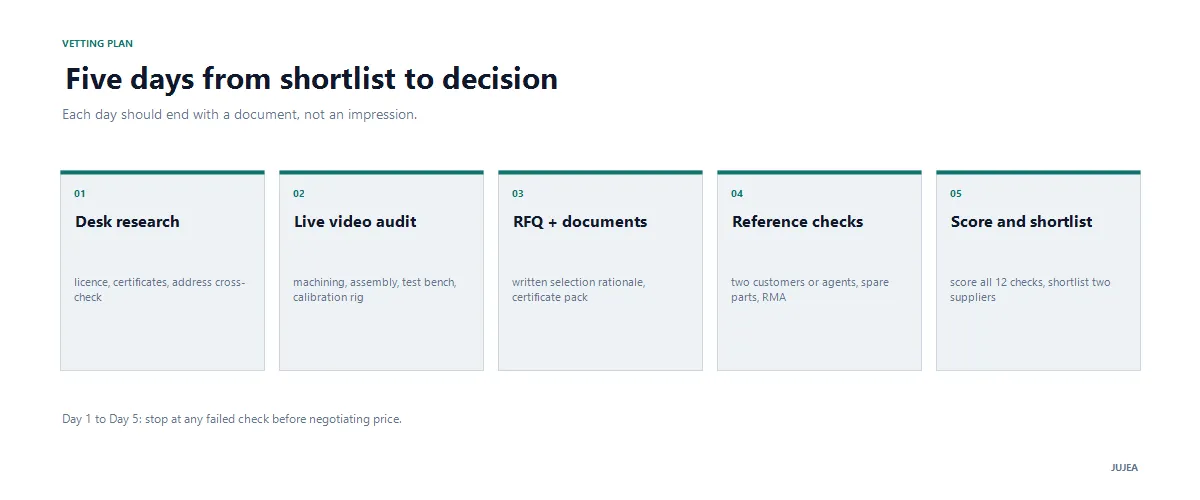
Run the checks in this order — each day should produce a document you can compare.
What Good Looks Like
As a concrete reference point, the evidence pack at JUJEA — an electromagnetic flowmeter manufacturer in China — includes ISO 9001/14001/45001 certification; CE, RoHS, TUV and SGS documentation; an in-house weighing-method calibration rig with traceable reference standards; 72-hour burn-in on every unit; calibration records retrievable by serial number; pipeline sensors from DN15 to DN1200 and insertion sensors from DN100 to DN3000; CR, FVMQ, PTFE/F4, FEP/F46 and PFA liners; 316L, Hastelloy C, Hastelloy B, titanium, tantalum and platinum electrodes; 4–20 mA, pulse/frequency, RS485/Modbus RTU, HART and Bluetooth outputs; and an 18-month warranty.
That is not a claim that every project needs every option. It is the list of questions a distributor should be able to ask any supplier — and get a document back. For hazardous-area projects, ask for the specific scheme and certificate number that applies to your market.
References and Further Reading
ISO 20456:2017 — Measurement of fluid flow in closed conduits: guidance for the use of electromagnetic flowmeters for conductive liquids. The reference standard for selection, installation and performance verification. Official preview (ANSI webstore)
ISO — ISO 9001: what does it mean in the supply chain? A plain-language guide to what a supplier's quality certification does and does not tell a buyer. ISO publication (PDF)
ILAC — ILAC MRA and signatories. Use the signatory search to check whether a calibration certificate's accreditation body is recognised under the ILAC Mutual Recognition Arrangement. ILAC MRA and signatories
FAQ
Q: How can I tell a manufacturer from a trading company? A: Cross-check three things: the business licence scope, the factory address on the ISO certificate, and a live video tour that walks from machining to assembly and test. Traders can arrange a tour at a partner factory, but they usually cannot show their own production records or calibration data.
Q: How do I verify ISO, CE or third-party certificates? A: Ask for the PDF and check the certificate number with the issuing body, confirm the scope names flowmeters, and confirm the certified address matches the manufacturing site. A logo on a website is not evidence; a verifiable certificate with a scope is.
Q: Do I need MID or ATEX certification? A: It depends on the application and the market. MID applies to meters used in regulated billing applications in the EU, such as water supply; ATEX, IECEx or NEPSI applies where the installation is in a hazardous area. Ask the supplier to name the scheme and certificate number that applies — a general "explosion-proof" claim is not enough.
Q: Is in-house calibration enough, or do I need a third-party report? A: It depends on the use. In-house wet calibration with traceable reference standards is adequate for most industrial monitoring; billing, regulatory or customer-acceptance applications may require a third-party traceable report. Ask which one is supplied and what the uncertainty statement says.
Q: How do I verify an accuracy class? A: Ask for the test data behind the claim, not just the datasheet number. The report should state the reference standards, the flow points tested, the method and the uncertainty. An accuracy class printed on a brochure without a supporting test record is a marketing claim.
Q: What warranty is reasonable for an electromagnetic flowmeter? A: Terms vary with the market and product family. What matters more than the number is whether the term is written, what is excluded, who pays freight, and how quickly a replacement is dispatched.
Q: What MOQ should I expect? A: It depends on configuration and branding, and it is usually negotiable for a repeatable standard model. Ask for the MOQ in writing and compare the total first-order cost — tooling, artwork, packaging and freight included — rather than the unit price alone.
Q: How long does production take? A: It depends on line size, liner, electrode and options, and it changes in peak season. Ask for the quoted lead time and the actual lead time of the last three comparable orders; the gap between the two is the number that matters.
Q: Can the factory put my brand on the meter? A: Most OEM-capable factories can. Confirm what is branded (nameplate, display, manual, packaging), whether the change affects certification documents, and who owns the artwork. Ask for photos or samples of previous private-label work.
Q: Which export documents should I receive? A: At minimum: certificate of origin, CE declaration, hazardous-area declaration where applicable, packing list, commercial invoice, and the calibration or test certificates. Ask for a sample set from a previous order — incomplete documents are slower to fix after shipment than before it.
Next Step
If you are shortlisting electromagnetic flowmeter manufacturers, send us your market profile and the configurations you sell most. We will return the evidence pack — certificates, calibration sample, datasheet and lead-time statement — in a form you can compare against any other factory.
Send your distributor profile · Browse JUJEA electromagnetic flowmeters
JUJEA electromagnetic flowmeters (DN15–DN1200 pipeline sensors; DN100–DN3000 insertion sensors) are produced in an ISO 9001/14001/45001 factory with CE/RoHS/TUV/SGS certification, individually calibrated on an in-house weighing-method rig, 72-hour burn-in tested, and covered by an 18-month warranty.
Ethan Liu
Ethan Liu is JUJEA's technical content specialist, translating complex sensor integration and industrial automation concepts into practical insights for engineers, system integrators, procurement professionals, and decision-makers worldwide.


 한국어
 français
 Deutsch
 Español
 italiano
 русский
 português
 العربية
 tiếng việt
 čeština