Two quotations for an electromagnetic flow meter of the same line size and the same flow range can differ by a wide margin — and neither supplier is necessarily overcharging. In most cases the gap comes from decisions that never appear in a one-line price request — liner material, electrode alloy, converter class, protection class, communication options, verification documentation, mechanical interfaces and commercial terms. This guide breaks down each driver, shows where buyers routinely overpay, and gives you an RFQ checklist that makes two quotes genuinely comparable.
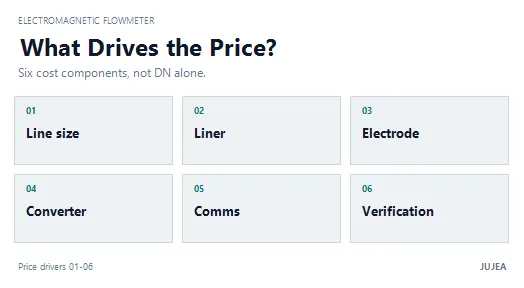
Six cost components — not line size alone — explain most of the price difference.
Short answer: the price of an electromagnetic flowmeter is set mainly by line size, liner material, electrode alloy, the converter's processor and electronics, communication and I/O modules, and verification/documentation scope. DN explains only part of the cost — two DN100 meters can sit in completely different price bands because of what is inside and around the tube. The converter processor is the most frequently underestimated cost block: at small line sizes the electronics can account for a large share of the quote, while at large line sizes the body, liner and flanges dominate.
Cost Drivers at a Glance
Cost driver | What changes | Impact on price | Where buyers overpay |
Line size (DN) | Bore, flange size, body material, shipping volume | High | Oversizing "for future capacity" and running below 0.3 m/s |
Liner material | Rubber (CR, FVMQ) vs fluoropolymer (PTFE/F4, FEP/F46, PFA) | High | Specifying PTFE for clean water that a rubber liner handles |
Electrode alloy | 316L vs Hastelloy C, Hastelloy B, titanium, tantalum, platinum | Medium–High | Buying tantalum or platinum for neutral, non-corrosive media |
Converter processor & electronics | Processor platform, sampling and filtering, diagnostics, firmware functions, I/O modules | High | A basic board that drifts at low flow, then paying for site visits |
Communication & I/O modules | 4–20 mA, pulse/frequency, RS485/Modbus, HART, Bluetooth; number of outputs | Medium | Paying for protocols the PLC or SCADA never uses |
Verification & documentation | Calibration certificate, traceability, material certificates, test reports | Medium | Skipping traceability, then paying for site rework |
Commercial terms | Order quantity, lead time, warranty, packaging, freight, spare parts | Varies | Rush orders and one-off lots that carry setup cost |
Optional add-ons | IP rating, split mounting, hazardous-area certification, custom flanges or lengths | Quoted separately | Buying IP68 or custom mechanical parts the site does not need |
Arrows and impact labels are directional, not price lists: every supplier prices these differently. Use the table to ask better questions, not to estimate a number.
Why Two Quotes for the Same DN Differ
A purchase requisition that says "DN100, 4–20 mA, PTFE" can be met by electromagnetic flowmeters that share almost nothing else. Before comparing prices, confirm these nine items are identical:
Liner grade and thickness — "PTFE" and "PTFE" can differ in processing, thickness and temperature rating.
Electrode alloy and finish — 316L, Hastelloy C, titanium, tantalum and platinum behave differently and cost differently.
Pressure rating — the same DN can be offered at different flange ratings.
Converter processor and I/O — the same sensor body can be paired with a basic board with fixed outputs or an advanced board with faster sampling, diagnostics, logging and digital protocols.
Protection class (optional configuration) — IP65, IP67 and IP68 are not interchangeable, and IP68 has immersion-depth conditions.
Communication scope — a pulse output and a Modbus RTU port are different products, not different settings.
Calibration scope — a factory functional test is not the same as a traceable calibration certificate.
Wetted-material certification — material certificates and compliance documents are priced separately by many suppliers.
Mechanical interfaces — flange standard (GB, DIN, ANSI, JIS), face-to-face length and grounding provisions.
If any of these is unspecified, the cheaper quote is not cheaper — it is a different product. Fixing them is a selection task before it is a pricing task: how to select an electromagnetic flowmeter covers liner, electrode, sizing and grounding.
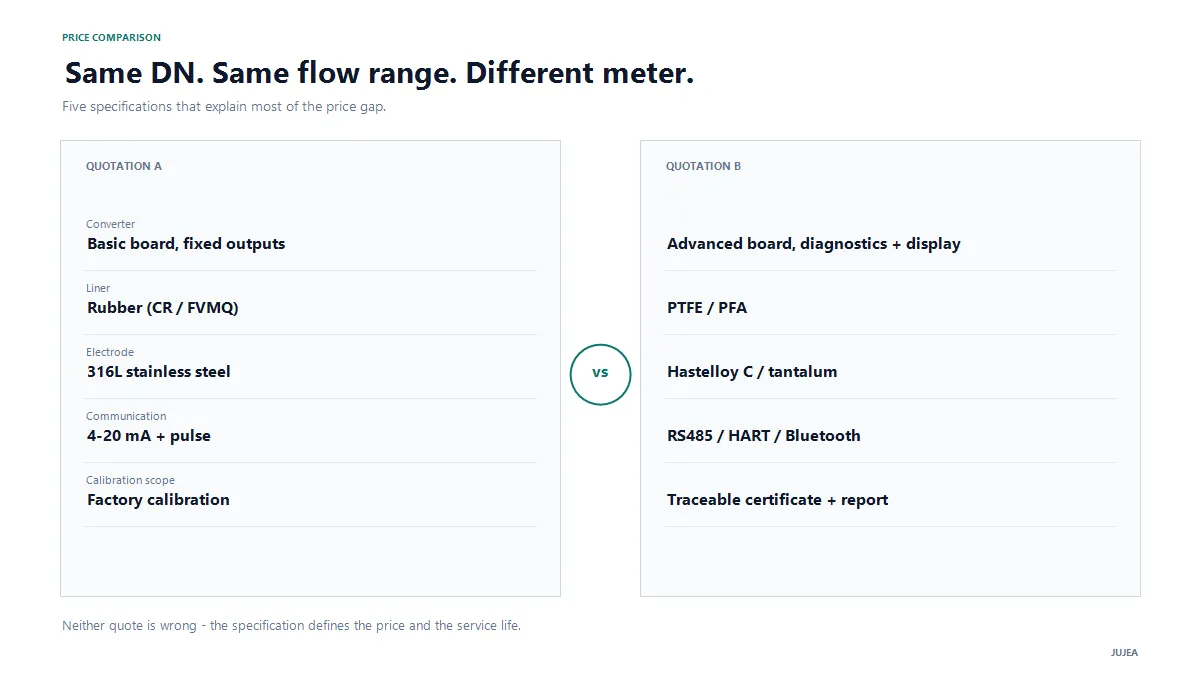
Same DN, same flow range — five specification choices that separate the two quotes.
The Core Cost Drivers in Detail
1. Line size: the cost driver everyone sees
On an electromagnetic flow meter, bore size drives the body, flanges, liner volume, shipping weight and machining time, so price generally rises with DN. But the relationship is not linear: flange size and pressure rating step up at specific DN boundaries, which is why a DN150 can cost disproportionately more than a DN100 in the same product family.
The expensive mistake is not choosing a large DN — it is oversizing. A meter running below 0.3 m/s loses accuracy and becomes sensitive to deposits, while a smaller bore at 1–3 m/s gives a better signal-to-noise ratio at lower cost. Size for the real operating range, not the maximum possible plant capacity.
Buyer tip: ask for the flow table at 0.3, 1, 3 and 7 m/s for each candidate DN, then choose the bore whose normal operating point sits in the middle of the range.
2. Liner material: usually the biggest specification jump
On an electromagnetic flow meter, the liner is the corrosion barrier and the single most consequential material decision. Rubber liners (CR, FVMQ) are the economical choice for water, wastewater and many non-aggressive slurries. Fluoropolymer liners (PTFE/F4, FEP/F46, PFA) cost more but extend chemical resistance and temperature capability.
Cost rises with the difficulty of the material: rubber compounds are simpler to bond and machine; fluoropolymers require more careful processing and inspection. PFA and FEP are typically positioned above standard PTFE in cost, and specialty thicknesses or high-temperature variants move the price again.
Where buyers overpay: specifying a fluoropolymer liner for clean, neutral water where a rubber liner is sufficient — or, worse, choosing rubber for a chemical service because it was cheaper on the quotation. The first wastes money; the second buys a premature failure.
3. Electrode alloy: small part, large price span
Electrodes are small, but the alloy can move the price noticeably because of raw material cost and machining difficulty. The common progression in cost is roughly: 316L stainless steel → Hastelloy C → titanium → tantalum → platinum. (Hastelloy B sits in the high-alloy group for reducing media.)
Where buyers overpay: buying tantalum or platinum for a benign medium "to be safe". Corrosion resistance is not additive — an exotic electrode does nothing for you if the liner or the process chemistry is the actual constraint.
Where buyers underpay: using 316L in a chloride-bearing or acidic service because it was the default. Electrode failure is one of the most expensive failure modes because it usually means replacing the sensor, not just the electronics.
4. Converter processor and electronics: the block buyers underestimate
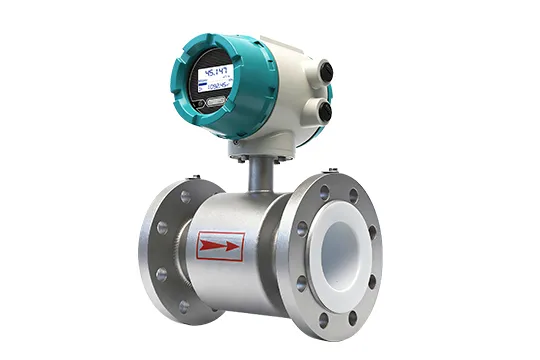
The converter head contains the processor board, the excitation driver, the analog front end and the I/O board. From the outside, two heads can look identical — same housing, same display window — while the electronics inside sit in different cost and performance classes. This is the block most often left as "standard" in an RFQ, and it is where a cheap quote is usually made cheap.
What moves the cost of the electronics:
Processor platform and sampling. The processor class, ADC resolution, sampling rate and digital filtering determine noise, response time and zero stability. Faster sampling and better filtering cost more — and show up as a reading that stays steady at low flow.
Signal-processing algorithms. Zero-point stability, low-flow correction (below 0.5 m/s on this product family), empty-pipe detection, electrode-contamination monitoring and noise rejection are firmware and algorithm work, not hardware decoration.
Diagnostics and self-check. Excitation-circuit monitoring, electrode status and fault logging turn a site visit into a phone call. Basic boards often omit them.
Firmware functions. Totalizer, batching, data logging, multi-language menus and flow correction are licensed or enabled per model.
I/O board. 4–20 mA, pulse/frequency, status outputs, RS485/Modbus RTU, HART and Bluetooth are module-level options; the number of outputs changes the board, not just a setting.
Power board and isolation. AC or DC supply and galvanic isolation are separate hardware.
Board-level testing. Burn-in and individual calibration of the electronics add cost — and remove early-life failures.
What is not part of the processor cost: enclosure material, IP rating and split mounting. Those are configuration options, priced separately. A buyer comparing "converter price" should compare the board, not the box.
The DN effect matters when you compare quotes: on small lines (roughly DN15–DN50) the electronics can represent a large share of the total, so board differences dominate the price gap. On large lines, the body, flanges and liner volume dominate — but the board still decides whether the meter is stable at low flow.
Buyer tip: ask for the converter datasheet and a list of which functions are standard, optional or licensed. Ask what the low-flow and zero-stability specifications are, which diagnostics are included, and whether the board can be replaced independently of the sensor. A potted, non-serviceable board turns a minor failure into a full-meter replacement.
As a reference point for function scope (not processor brand): the converter used in JUJEA's DN15–DN1200 electromagnetic flowmeters provides 4–20 mA (loop resistance up to 750 Ω), pulse/frequency output up to 5,000 Hz, RS485/Modbus RTU, HART and Bluetooth 4.0, a 128×64 LCD or OLED display, 100–240 VAC power, electrode-contamination diagnostics and low-flow correction below 0.5 m/s (Pangu IMQ53F manual).
5. Communication and I/O modules
The interface list is where options accumulate: output count, pulse/frequency capability, status outputs, RS485/Modbus, HART and Bluetooth. Each is usually priced as a line item rather than bundled.
The most common waste is buying communication the control system cannot use. A skid with a simple PLC analog card does not need HART; a plant with a Modbus network does not need a second 4–20 mA loop. Specify the interface your controls team will actually commission — and confirm the protocol details (baud rate, parity, register map) before the order, not after the meter arrives.
Buyer tip: ask the controls engineer for the exact interface list before the RFQ.
6. Verification, documentation and commercial terms
Two meters with identical hardware can carry different prices because of what comes with them:
Calibration: a traceable calibration certificate, multi-point verification and test records add cost — and are worth it wherever the reading affects billing, quality release or regulatory reporting.
Documentation: material certificates, pressure-test reports, and compliance declarations are often priced separately.
Commercial: order quantity, lead time, packaging for export, spare parts kits and warranty terms all move the landed cost.
A low unit price with no documentation is not a saving if the meter cannot be accepted by your customer, your auditor or your insurer.
Optional features priced separately
Protection class, mounting style and mechanical customisation are configuration options rather than core cost components. They should be quoted as separate line items so they do not distort the comparison of the meter itself:
IP rating. IP65 suits a dry indoor installation. IP68 adds sealing, cable-entry and testing requirements, and its immersion or burial depth must be stated. If the site needs it, it is a requirement; if not, it buys nothing.
Split mounting. A separate housing, a signal cable (typically 10 m standard, longer runs to order) and installation labour. It keeps electronics away from heat, vibration and flooding, and makes service easier.
Hazardous-area certification. Where the installation requires it, certification is a separate scope and must be quoted explicitly.
Mechanical customisation. Non-standard flange drilling, face-to-face length and special materials.
The Cost You Should Compare: Life-Cycle Cost, Not Purchase Price
Purchase price is only the first line. A practical total cost of ownership (TCO) model is:
TCO = purchase price + installation + commissioning + energy + maintenance + calibration + downtime
Where the energy term can be estimated from pressure loss:
Pressure-loss power (kW) = Δp (kPa) × Q (m³/h) ÷ (3600 × η)
Δp = permanent pressure loss across the meter
Q = operating flow rate (m³/h)
η = pump efficiency (use your own figure)
Annual energy cost = pressure-loss power × operating hours × electricity tariff
Fill this in with your own numbers; no supplier can do it for you. The point is not the exact figure — it is that a full-bore electromagnetic flowmeter has no obstruction in the flow path, so its permanent pressure loss is low. Over a multi-year run, that difference can outweigh a modest purchase-price gap, especially on large lines running continuously.
Non-price costs that bite later: unplanned downtime (production loss usually dwarfs the meter price), rework from a wrong liner or electrode, and expedited freight for a replacement.
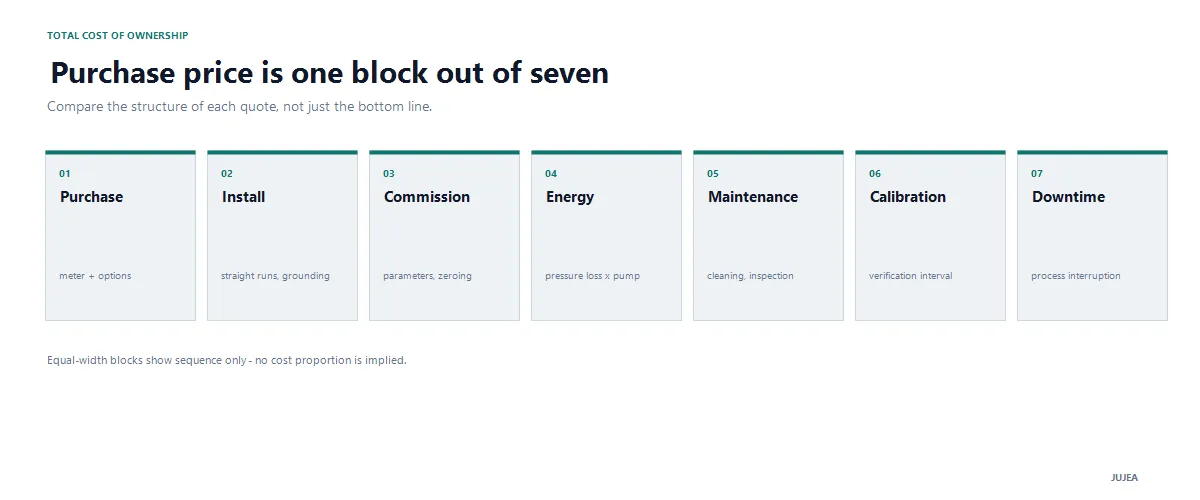
Purchase price is one of seven cost blocks. The blocks are equal width by design — no cost proportion is implied.
Where to Spend and Where to Save
Spend here | Save here |
Liner and electrode matched to the actual chemistry, concentration and temperature | Exotic alloys on neutral media |
A converter board with stable low-flow performance and real diagnostics | Protocols and display features the control system will never use |
Traceable calibration when the reading drives billing, quality or compliance | Multi-point certificates where a single-point check is enough |
Grounding provisions and correct installation accessories | Unnecessary custom flanges and non-standard lengths |
Spare parts availability and documented lead times | Communication options the control system cannot use |
A bore sized for the real operating range | Oversizing "for the future" |
RFQ Checklist: Make Two Quotes Comparable
Send this list with every inquiry. Suppliers who answer it precisely are usually the ones worth shortlisting.
# | Item to specify |
1 | Medium, concentration, temperature range and conductivity |
2 | Normal / minimum / maximum flow rate, and required turndown |
3 | Line size and pipe schedule; available straight run upstream and downstream |
4 | Liner material requested, or the chemistry for the supplier to recommend |
5 | Electrode alloy requested, or the chemistry for the supplier to recommend |
6 | Converter board: processor platform, sampling and low-flow performance, diagnostics required |
7 | Converter model and datasheet; firmware functions and I/O — which are standard, optional or licensed |
8 | Pressure rating and flange standard (GB, DIN, ANSI, JIS) |
9 | Installation environment: indoor/outdoor, wash-down, buried, immersion depth |
10 | Required outputs and protocol (4–20 mA, pulse, RS485/Modbus, HART) |
11 | Calibration and documentation scope (certificate type, material certs, test reports) |
12 | Delivery location, required lead time, and warranty terms |
If a quote does not state liner grade, electrode alloy, converter class, protection class and calibration scope, ask for a revised quotation before comparing numbers. A supplier who can evidence these items on request is the other half of the comparison — see the electromagnetic flowmeter manufacturer checklist.
A Note for Dealers and OEM Buyers
For distributors and OEM skid builders, unit price is only one part of the commercial equation. Four items deserve equal attention:
Configuration discipline: a repeatable standard configuration reduces cost and lead time for both sides. Custom options should be the exception, not the default.
Documentation package: certification and test records determine whether your customer can accept the meter without re-testing.
Spare parts and service: a slightly higher unit price with local spare-part availability is often cheaper than a low price with a six-week replacement chain.
Warranty administration: clarify what is covered, who pays freight, and how claims are handled before the first order — not after the first failure.
FAQ
Q: Why is an electromagnetic flowmeter more expensive than a turbine meter of the same size? A: It has no moving parts, but it adds a liner, electrodes, a signal converter and calibration work. The trade-off is usually lower maintenance and no wear on a rotor, which often makes it cheaper over the life of the installation — particularly in dirty or abrasive media.
Q: Does a larger DN always mean a higher price? A: Generally yes, but not proportionally. Flange size, pressure rating and liner volume step up at certain DN boundaries, so a DN150 can cost disproportionately more than a DN100 in the same family.
Q: Are IP rating and split mounting included in the base price? A: They are configuration options, usually quoted as separate line items. State the environment (indoor, wash-down, buried, immersion depth) and ask for the add-on price explicitly, so the base meter comparison stays like-for-like.
Q: How much of the price is the converter? A: It depends on line size and the electronics inside the head. On small lines (roughly DN15–DN50) the processor board can account for a large share of the quote; on large lines the body, liner and flanges dominate. Compare processor performance, low-flow stability and diagnostics — not the enclosure.
Q: What should I compare between two converter heads? A: The processor platform and sampling, zero and low-flow stability, the diagnostics list, firmware functions (totalizing, batching, logging) and the I/O modules. Enclosure and IP rating are configuration options, not indicators of board quality.
Q: Is the cheapest meter a false economy? A: It can be. The common failure modes — electrode corrosion, liner damage, moisture ingress and missing calibration records — are exactly where low-cost designs cut corners. The cost of one premature sensor replacement usually exceeds the initial saving.
Q: Do I need a calibration certificate? A: If the measurement affects billing, product quality, regulatory reporting or customer acceptance, yes — and it should be traceable. If the meter is for internal monitoring only, a factory functional test may be sufficient. ISO 20456 provides guidance on verification practice for electromagnetic flowmeters.
Q: How can I tell whether a quote is complete? A: Compare the nine specification items in this guide: liner grade, electrode alloy, pressure rating, converter class, protection class, communication scope, calibration scope, material certification and mechanical interfaces. If any is missing, the quote is not comparable.
Q: Can I reduce cost by choosing a smaller DN? A: Often, yes — provided the smaller bore keeps normal flow within a sensible velocity range (roughly 1–3 m/s) and above the meter's minimum. Undersizing causes accuracy loss and noise; sizing for the real operating range is the correct optimisation.
References and Further Reading
ISO 20456:2017 — Measurement of fluid flow in closed conduits: guidance for the use of electromagnetic flowmeters for conductive liquids. The reference standard for selection, installation and performance verification. Official preview (ANSI webstore)
OMEGA Engineering — Flow Control technical reference. A practical overview of flowmeter technologies and selection trade-offs. Technical reference
Endress+Hauser — Proline Promag H 10 Technical Information. Manufacturer documentation illustrating how wetted-material and grounding accessories are specified. Technical information (PDF)
Next Step
If you are comparing quotes, send us the twelve items above with your process data. Our engineers will return a configured recommendation with the liner, electrode, protection class and documentation scope stated explicitly — so you can compare like with like.
Send your application data · Browse JUJEA electromagnetic flowmeters
JUJEA electromagnetic flowmeters (DN15–DN1200 pipeline sensors) are produced in an ISO 9001/14001/45001 factory with CE/RoHS/TUV/SGS certification, individually calibrated on an in-house weighing-method rig, 72-hour burn-in tested, and covered by an 18-month warranty.
Ethan Liu
Ethan Liu is JUJEA's technical content specialist, translating complex sensor integration and industrial automation concepts into practical insights for engineers, system integrators, procurement professionals, and decision-makers worldwide.


 한국어
 français
 Deutsch
 Español
 italiano
 русский
 português
 العربية
 tiếng việt
 čeština