Steam is the one medium where the meter cannot be chosen from the line size alone. The same DN80 pipe carries 500 kg/h at 0.2 MPa and 500 kg/h at 1.6 MPa, but the steam occupies seven times more space in the first case — so the velocity, the bore and sometimes the principle all change. Add the difference between saturated and superheated steam, and the dryness fraction nobody measures, and steam selection becomes a question of what the meter is allowed to assume.
Short answer: saturated or superheated steam on a line from DN15 to DN300 with a defined pressure and temperature goes to a vortex meter with built-in temperature and pressure compensation, which outputs mass flow directly. Use an uncompensated vortex only where pressure and temperature genuinely do not move. A metal tube rotameter is for local indication on small utility lines. Differential pressure remains the incumbent on very large mains, at the cost of permanent pressure loss and a narrow range. Thermal mass and turbine meters cannot measure steam at all.
Steam Is Three Mediums, Not One
A steam line is not carrying "steam" in the way a water line carries water. It is carrying one of three things, and each one changes what the meter has to know:
Saturated steam. Vapour in equilibrium with liquid water at the same pressure and temperature. Pressure and temperature are not independent — if you know one, the steam tables give you the other, along with the density. This is the common case, and it is also the case where the meter can be fooled, because saturated steam is usually slightly wet.
Superheated steam. Vapour heated above its saturation temperature. Pressure and temperature are now independent, so density needs both, and the superheat margin tells you how far the steam is from condensing in the pipe.
Condensate and flash steam. Liquid water, or a two-phase mixture downstream of a trap or a control valve. Neither is a clean vortex measurement, and both are where meters get damaged.
What each duty requires from the meter:
Duty | Independent variables | What the meter needs | Typical mistake |
Saturated steam | One: pressure or temperature | One sensor, tables for the rest | Feeding a temperature that has already drifted into superheat |
Superheated steam | Two: pressure and temperature | Both sensors, superheat margin known | Using saturated-steam density and under-reading by the margin |
Wet saturated steam | One, plus dryness fraction | One sensor, plus an honest dryness assumption | Assuming x = 1.0 because the boiler says so |
The practical consequence: a steam meter must be told which of these it is measuring, because the same volumetric reading converts to a different mass in each case. A vortex meter measures volume; the mass comes from the density you feed it. Feed it the wrong density and it will report a wrong mass with complete confidence.
The Number You Are Buying Is Mass, Not Volume
Steam is bought, sold and reported by mass — kilograms per hour, tonnes per month, or gigajoules of energy. Nobody buys cubic metres of steam, because a cubic metre of steam is a different amount of heat at every pressure.
That matters because the meter measures volume. The conversion is where the sizing lives, and it is dramatic:
Absolute pressure | Saturation temperature | Specific volume of dry saturated steam | Velocity at 500 kg/h in DN50 | in DN80 |
0.2 MPa | 120 °C | 0.886 m³/kg | 63 m/s | 24 m/s |
0.5 MPa | 152 °C | 0.375 m³/kg | 27 m/s | 10 m/s |
0.8 MPa | 170 °C | 0.240 m³/kg | 17 m/s | 6.6 m/s |
1.0 MPa | 180 °C | 0.194 m³/kg | 14 m/s | 5.4 m/s |
1.6 MPa | 201 °C | 0.124 m³/kg | 8.8 m/s | 3.4 m/s |
Same mass, same pipe, five different velocities — a factor of seven between the lowest and the highest pressure. Read the table the other way and the sizing rule appears: at low pressure, the same steam flow needs a bigger bore. A DN50 that is comfortable at 1.0 MPa becomes an erosion problem at 0.2 MPa, where the velocity passes 60 m/s.
Two sizing habits follow, and both are cheap:
Size on the lowest pressure the line will ever run at, not the normal operating point. Steam headers lose pressure at peak demand, and the meter that was fine at design conditions is the one that erodes at the end of the shift.
Check velocity at minimum and maximum flow, in m/s, against the meter's own curve. A vortex meter's usable band is usually quoted in velocity, not in m³/h, precisely because the volume changes with pressure while the physics does not.
The band marked on the chart — 10 to 50 m/s — is a common reference, not a rule. Three things move it: the model (small-bore vortex meters typically need more velocity than large ones), the steam condition (at high temperature and pressure the lower limit rises, because the shedding signal weakens as density falls and the body heats), and erosion policy (50 m/s is where erosion risk starts to matter, not a hard ceiling). Treat the band as a question to ask the supplier, and take the answer in writing for your pressure and temperature.
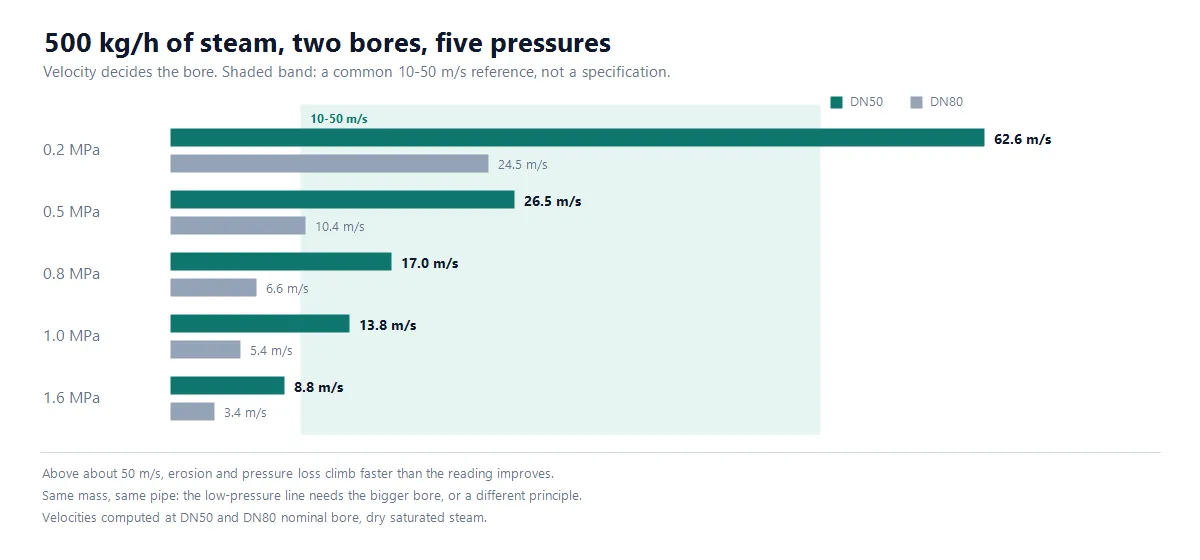
Same mass, same pipe: only the pressure changed.
The Five Facts That Pick the Steam Meter
1. Saturated or superheated? This decides what the compensation has to know. Saturated steam needs one input — pressure or temperature — because the tables couple them. Superheated steam needs both, and it needs the meter to know it is superheated, otherwise the density is wrong by the superheat margin.
2. How dry is the steam? Saturated steam in a real header is rarely 100% vapour. A dryness fraction of 0.95 means 5% of the mass is liquid droplets travelling at the same velocity. That liquid does two things: it biases the reading, and it erodes the bluff body. The section below deals with this properly, because it is the most commonly skipped number in steam metering.
3. What pressure and temperature class? This is a hardware question, not a preference. Our steam range covers DN15–DN300 at 1.6 MPa as standard, with higher ratings by agreement, and −20 to 250 °C as standard with a 250–350 °C option. A line at 300 °C and 2.5 MPa is a different order code, not a different datasheet line.
4. What is the real flow range? Steam demand swings with production, and turndown is where cheap meters fail. Our vortex units are available at 1:6, 1:10 and 1:20 turndown — the ratio you pick determines whether the night shift is measurable. A 1:6 meter on a line that drops to a fifth of design reads zero for eight hours a day.
5. Does the reading have to become energy? If the number feeds a cost allocation or an energy report, you need enthalpy as well as mass, which means temperature and pressure anyway — and it usually settles the compensation question in favour of a compensated meter.
The Comparison Table
Type | Principle | Best for | Fails when | Typical accuracy | Turndown |
Vortex, compensated | Shedding frequency plus built-in P/T | Saturated and superheated steam, DN15–DN300 | Wet steam, low velocity, heavy vibration | Class 1.0 | 1:6 to 1:20 |
Vortex, uncompensated | Shedding frequency only | Steam at genuinely fixed pressure and temperature | Any pressure or temperature drift | Class 1.0–1.5 | 1:6 to 1:20 |
Metal tube rotameter | Float height in a tapered tube | Local indication, small utility lines, purge steam | Billing accuracy, varying density, dirty steam | ±2.5% FS | 1:10 |
Orifice plate (concentric) | Square-root of differential pressure | Very large mains, high pressure and temperature | Low flow, wet steam, anywhere pressure loss costs money | ±1–2% | about 1:3 |
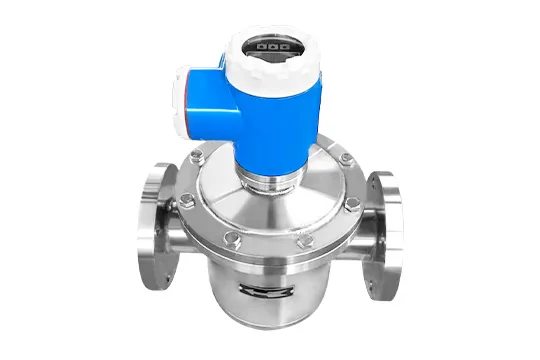
Coriolis | Vibration of a measuring tube | Small high-value steam lines where mass and density matter | Large lines, high temperature, tight budget | ±0.2% on liquid | Very wide |
The accuracy, turndown and velocity figures above are typical values for each class of meter at reference conditions. They are a starting point for shortlisting, not a specification: confirm the number against the model's own datasheet, at your pressure, temperature and steam condition, before the bore is fixed.
When Each Type Is the Right Answer
Vortex with compensation: the default
Choose it when the steam is saturated or superheated, the line is between DN15 and DN300, and the pressure or temperature moves at all during the week. The meter measures the shedding frequency, converts it to volume, and multiplies by the density it computes from the built-in temperature and pressure sensors — so the output is mass flow, not a volume that needs a spreadsheet.
Avoid it when the velocity falls below the meter's floor, the pipe vibrates hard, or the steam is wet enough that droplets are hitting the bluff body. Our units specify an allowable vibration acceleration of 0.2 g; a meter bolted to a line beside a reciprocating compressor will find more than that, and the reading will show it.
The setting that matters: low-flow cut-off. Set it too low and the meter reports noise as flow during shutdown; set it too high and you lose the legitimate minimum. It should be set from the velocity floor at the lowest operating pressure, not from a round number.
Vortex without compensation: only for genuinely fixed conditions
Choose it when the line runs at a pressure and temperature that do not move — a test stand, a fixed-pressure process, a dedicated superheater outlet where the setpoint never changes. In that case the density is a constant you can enter once, and the cheaper meter is the correct engineering choice.
Avoid it when there is any chance the pressure will drift. An uncompensated vortex on a header that swings between 0.6 and 0.9 MPa will be wrong by roughly 30% low at one end of the swing and close to 50% high at the other, and it will look perfectly healthy the whole time.
Metal tube rotameter: local indication, honest limits
Choose it when someone needs to see the flow at the valve, on a small steam line. It needs no power, survives high temperature, and reads instantly.
Avoid it when the number has to stand up as a billing figure. A 4–20 mA remote output is available on metal tube rotameters, so "can it be recorded" is not the question — the question is the error. Float height depends on density, so a pressure change moves the reading, and the accuracy is a percentage of full scale rather than of reading: at a quarter of scale, a ±2.5% FS meter is really ±10% of the value it shows.
Orifice and differential pressure: the incumbent you may be replacing
Choose it when the main is very large, the pressure and temperature are high, and the plate is already installed with a working compensation package. Rip-and-replace is rarely justified on a line that is measured adequately.
Avoid it when the flow range is wide or the energy bill is visible. A concentric plate's turndown is roughly 3:1, its pressure loss is permanent, and its sharp edge wears — which changes the discharge coefficient and the reading, slowly enough that nobody notices.
One correction to the folklore: the 3:1 figure belongs to the standard concentric orifice plate. Other differential-pressure primaries — wedge, V-cone, nozzle — are commonly quoted at 5:1 to 10:1, because their geometry keeps a usable differential at lower flow. If someone tells you "differential pressure is always 3:1", they are describing one primary element, not the family.
Coriolis: the niche
Choose it when the steam line is small, the value of the measurement is high, and density as well as mass matters. It measures mass directly, so wetness affects it differently from a volumetric meter.
Avoid it when the line is large or the temperature is high — measuring tubes and their electronics have limits that steam reaches easily, and the price scales badly with bore. High-temperature steam can be handled with a thermal-jacket option on some models, but that is a special order, not a catalogue default.
Two corrections to the usual sales line. First, Coriolis is not immune to wet steam: two-phase flow still disturbs the vibrating tube, it just disturbs it through a different mechanism — damping and phase decoupling rather than a shifted shedding frequency. Do not read "measures mass directly" as "wet steam is fine". Second, the headline accuracy is a liquid figure; the gas and steam figure is looser and has to be asked for separately.
Dryness Fraction: The Number Nobody Measures
Dryness fraction is the share of the mass that is vapour. At x = 1.0 the steam is dry saturated; at x = 0.95, five percent of the mass is liquid water travelling as droplets. Almost no site measures it, and it quietly biases every volumetric steam meter on the line.
The arithmetic is simple. A vortex meter measures volume and assumes a density. If it assumes dry saturated steam, the mass it reports is Q ÷ v_g. The true mass is Q ÷ (x × v_g). So the reported mass is low by the factor x:
One assumption is buried in that step: the droplets travel at the same velocity as the vapour. In a real pipe they do not, exactly — the liquid fraction slips, and it slips more where the flow is slow or the line turns. Once droplets separate, the error stops following the simple factor and can move in either direction. Treat the numbers below as the size of the risk, not as a correction factor you can apply to a totaliser.
At x = 1.00, no error.
At x = 0.95, the meter under-reads by 5%.
At x = 0.90, the meter under-reads by 10% — and the boiler house is being under-charged by a tenth.
Dryness fraction | Reported mass against true mass | On 500 kg/h, the gap |
1.00 | correct | 0 kg/h |
0.98 | 2% low | 10 kg/h |
0.95 | 5% low | 25 kg/h |
0.90 | 10% low | 50 kg/h |
0.85 | 15% low | 75 kg/h |
Five percent does not sound like much until it is applied to a year of steam. It also does not stay constant: wetness depends on boiler carry-over, trap performance, insulation and load, so the error moves with the weather and the shift pattern.
How to tell whether your steam is wet. What follows is a verdict, not a measurement. A number requires a throttling calorimeter on a sample, or a heat-balance check against the boiler, and neither is a field instrument you bolt on — they are tests you schedule. What the pressure and temperature will tell you is whether the assumption is safe:
If the measured temperature sits within a few degrees of saturation for the measured pressure, the steam is saturated and almost certainly slightly wet. Superheated steam is not within a few degrees of anything.
If the superheat margin is under about 10 °C, condensate is likely somewhere in the line, and the meter is probably not seeing dry vapour.
If traps downstream are passing continuously, or the line has a history of water hammer, assume wetness until proven otherwise.
What to do about it. Fit a separator or a properly sized trap set upstream, insulate the line, and take the temperature sensor seriously — a compensated meter that knows the steam is at saturation will at least not pretend it is superheated. Where the wetness is structural and the money is large, the honest answer is a different principle or an agreed correction factor, not a longer datasheet.
From kg/h to kW: What Energy Metering Actually Requires
Most steam meters exist to allocate cost. The conversion from mass to energy is:
kW = (kg/h ÷ 3600) × (h_steam − h_condensate)
with enthalpies in kJ/kg. The steam enthalpy comes from the pressure and temperature the meter already has; the condensate enthalpy comes from the return line temperature, which the meter does not have. That is the part people forget: an energy figure needs a second temperature, usually at the condensate return, or an agreed fixed value written into the contract.
A worked example. 500 kg/h of saturated steam at 0.8 MPa, condensate returning at 90 °C:
h_steam ≈ 2,769 kJ/kg, h_condensate ≈ 377 kJ/kg, so Δh ≈ 2,392 kJ/kg
kW = (500 ÷ 3600) × 2,392 ≈ 332 kW
Now change only the dryness: at x = 0.95 the true mass is 5% higher, so the energy is about 349 kW. The meter still reads 332. Nobody sees the difference on the display; it appears on the utility bill at the end of the month.
Installation Rules for Steam
Straight run. A vortex needs roughly 15–20 diameters upstream and 5 downstream, and more after a control valve, a reducing station or a double bend. Steam lines are usually short on space, which is exactly why this gets compromised — and why the resulting error is blamed on the meter.
Orientation. Horizontal lines with the meter installed so that the sensor is not sitting in a low pocket where condensate collects; vertical lines with flow upward, so gravity keeps liquid away from the bluff body. Never install where the body can fill with water during a shutdown. Upflow helps, but it does not dry the steam: a vertical riser still needs a separator or a working trap set upstream. If the line is wet, orientation changes where the water goes, not whether it is there.
Upstream of the control valve, not downstream. Downstream of a reducing valve the steam is often wet and the velocity profile is distorted; upstream it is closer to the conditions the meter was sized for. If the meter must go downstream, expect a shorter sensor life and a wetter reading.
Compensation sensor placement. The pressure tap and the temperature probe should see the same steam the meter sees, at the same conditions — a temperature probe 20 m downstream in an insulated line is measuring something else. Keep them close to the meter body, and insulate the probe pocket.
Insulation. An uninsulated meter body in a cold plant room condenses steam internally. The reading drops, the body corrodes, and the diagnosis is usually "bad meter" rather than "missing insulation".
Vibration. Vortex meters read frequency, so external vibration is noise. Our units are specified to 0.2 g; anything above that needs isolation, relocation, or a different principle.
What to Put in the RFQ
Saturated or superheated, and the normal superheat margin if superheated
Pressure — minimum, normal and maximum, stated as gauge or absolute
Temperature at the same three conditions
Mass flow in kg/h at minimum, normal and maximum (or the volume flow and conditions, so it can be converted)
Line size, schedule and material
Dryness fraction if known, and how it was determined
Straight run available, orientation, and distance to the nearest control valve
Ambient conditions, vibration sources nearby, and hazardous area classification
Outputs and power — pulse, 4–20 mA, RS485, HART; 3.6 V battery or 24 V DC
Whether the number feeds energy allocation, and if so where the condensate temperature comes from
Item 4 is the one that gets answered in m³/h. Convert it before sizing, or the bore will be chosen against a number that changes with the weather.
FAQ
Q: Can a vortex flow meter measure both saturated and superheated steam? A: Yes, with the same body, provided the meter is configured for the phase it is seeing. Saturated steam needs one input because pressure and temperature are coupled; superheated steam needs both. Tell the supplier which one you have, because the density calculation and the temperature class both depend on it.
Q: Why does my steam meter read low compared with the boiler output? A: Usually wetness or an uncompensated pressure drop. A meter assuming dry saturated steam under-reads by the dryness fraction — about 5% at x = 0.95 — and a line that has lost pressure since commissioning changes the actual volume for the same mass. Check the dryness assumption before suspecting the sensor.
Q: Do I need temperature and pressure compensation? A: If the pressure or temperature moves and the number is used for cost, yes. An uncompensated vortex is only correct at the density it was configured for; across a 0.6 to 0.9 MPa swing, the error runs from about 30% low to about 50% high.
Q: What turndown do I need for steam? A: Enough to cover the night minimum. Our vortex units are available at 1:6, 1:10 and 1:20. Choose from the real minimum and maximum mass flows at the lowest operating pressure, not from the boiler's rated output.
Q: Can I use a thermal mass or turbine meter on steam? A: No. A thermal mass sensor would be measuring a condensing medium, and a turbine's bearings and seals are not built for steam temperature and wetness. Vortex, differential pressure and variable area are the practical options.
Q: What steam temperature can your meters take? A: −20 to 250 °C as standard, with a 250–350 °C option, in SS304 bodies with SS316L on request. Pressure rating is 1.6 MPa as standard, with higher ratings by agreement. Anything beyond that is a specification conversation, not a catalogue choice.
Q: How do I know if my steam is wet? A: Compare the measured temperature with the saturation temperature for the measured pressure. Within a few degrees means saturated and probably slightly wet; a superheat margin under about 10 °C means condensate is likely present. Continuous trap discharge or a history of water hammer is confirmation enough to act.
Q: Where should the meter go relative to the control valve? A: Upstream, wherever possible. Downstream of a reducing valve the steam is often wet and the profile is disturbed, which biases the reading and shortens sensor life.
Q: How is steam flow converted to energy? A: Multiply mass flow by the enthalpy difference between the steam and the returning condensate: kW = (kg/h ÷ 3600) × (h_steam − h_condensate). The steam enthalpy comes from the meter's pressure and temperature; the condensate enthalpy needs a second measurement or an agreed contract value.
Q: What accuracy can I expect on steam? A: Our steam range is offered at Class 1.0, 1.5 and 2.5. That class is a laboratory figure at reference conditions, not an installed one: on site the number also depends on straight run, dryness, compensation and velocity. A Class 1.0 meter fed a dry-steam assumption on wet steam is not a 1% measurement.
Next Step
Send the ten RFQ items, including the pressure at minimum flow and an honest answer about dryness, and we will size the bore against velocity rather than against a round number. If you are still deciding whether the line needs a vortex at all — some steam duties belong to differential pressure — start with the seven flow meter types compared and then come back for the steam-specific detail. For gas duties on the same plant, see how to select a gas flow meter.
Talk to our engineers · Steam flow meters
Ethan Liu
Ethan Liu is JUJEA's technical content specialist, translating complex sensor integration and industrial automation concepts into practical insights for engineers, system integrators, procurement professionals, and decision-makers worldwide.


 한국어
 français
 Deutsch
 Español
 italiano
 русский
 português
 العربية
 tiếng việt
 čeština