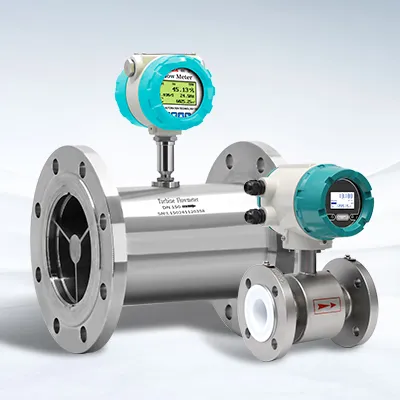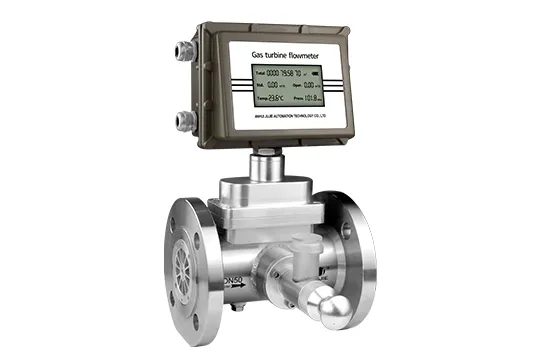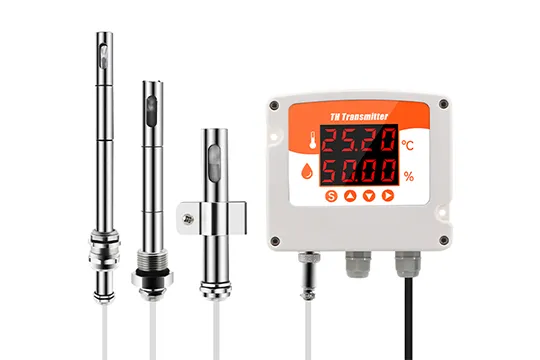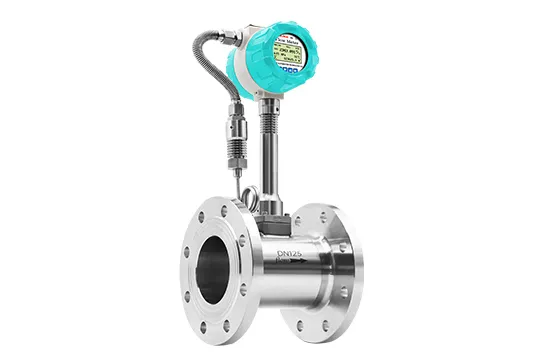
The type of flow meter is decided by the process, not by preference. Five facts settle most cases before a model number is ever discussed: whether the fluid conducts electricity, whether it is liquid, gas or steam, how viscous it is, whether it carries solids, and how wide the flow range is. Get those five right and the technology chooses itself; get one wrong and no amount of configuration will save the installation. This guide to flow meter types compares seven technologies on those five facts, shows where each one is the wrong answer, and gives the questions to put in an RFQ.
Short answer: conductive liquids in a full pipe go to an electromagnetic flowmeter; clean low-viscosity liquids — water, fuel, light hydraulic oil — or gases, in a separate gas turbine, with steady flow go to a turbine; steam, gas and clean low-viscosity liquids at adequate velocity go to a vortex; clean liquids in existing large pipes go to a clamp-on ultrasonic; gas mass flow without temperature and pressure compensation goes to a thermal mass meter; viscous, lubricating liquids such as hydraulic oil at low flow go to an oval gear meter, or to a circular gear meter at millilitre rates; and when the reading has to be mass, or the fluid changes between liquid and gas duty, a Coriolis meter is the one that does not need the conductivity or viscosity question answered at all.
The Five Process Facts That Pick the Type
Before comparing datasheets, answer these in writing. Every wrong meter choice we see traces back to one of them being assumed rather than measured.
Fact | Why it decides the type | Typical failure if assumed |
Conductivity | Electromagnetic metering needs a conductive liquid; oils, solvents and gases are out | Meter installed, reads zero or drifts, project delayed |
Phase | Liquid, gas and steam use different principles entirely | A liquid meter specified for a gas line, or the reverse |
Viscosity | High viscosity rules out turbine, vortex and most ultrasonic | Rotor stalls, vortex signal disappears, reading flatlines |
Solids and abrasion | Particles wear turbines and gear meters; they blind electrodes | Bearing seizure, electrode coating, repeat calibration |
Flow range | Low minimum flow and wide turndown limit the options | Meter reads nothing at night, or runs above its range |
Coriolis is the exception to the conductivity row: it measures mass directly, so conductivity and viscosity do not decide it — pressure drop, line size and cost do.
Two secondary facts then narrow the shortlist: the accuracy the application actually needs, and whether the pipe can be opened for a spool-piece meter or must stay in service.
The Comparison Table
The flow meter types below are ordered from the most common in water and process duty to the most specialised. Ranges are typical for industrial instruments in this class. Treat them as a shortlist tool, not as a specification — confirm against the datasheet for the model you intend to buy.
Type | Principle | Best for | Fails when | Typical accuracy | Turndown |
Electromagnetic | Faraday induction in a conductive liquid | Water, wastewater, slurries, acids and bases in full pipes | Non-conductive liquids, gas, partially full pipes | ±0.5% | Very wide |
Turbine | Rotor speed proportional to velocity | Clean low-viscosity liquid, or gas in a separate unit | Viscous, abrasive or pulsating flow; low flow | ±0.5–1% | Moderate |
Vortex | Frequency of vortices shed behind a bluff body | Steam, gas, low-viscosity liquids at adequate velocity | Low velocity, high viscosity, wide range changes | ±1% | Moderate |
Coriolis | Vibration of a measuring tube, read as mass flow | Liquids and gases, mass or density-critical duty, viscous fluids | Large line sizes, low pressure, two-phase flow, tight budget | ±0.1–0.2% | Very wide |
Ultrasonic (transit-time) | Difference in transit time across the pipe | Clean liquids, large pipes, retrofit without cutting | High entrained gas or solids, scaled or lined pipe, part-full sections | ±1% | Wide |
Thermal mass | Heat carried away by the gas stream | Gas mass flow, compressed air, nitrogen, burner gas | Liquids, dirty or condensing gas, unknown composition | ±1–2% | Wide |
Oval gear | Volumetric displacement of meshing gears | Viscous, lubricating liquids at low flow | Abrasive or non-lubricating fluids, high flow | ±0.5% | Moderate |
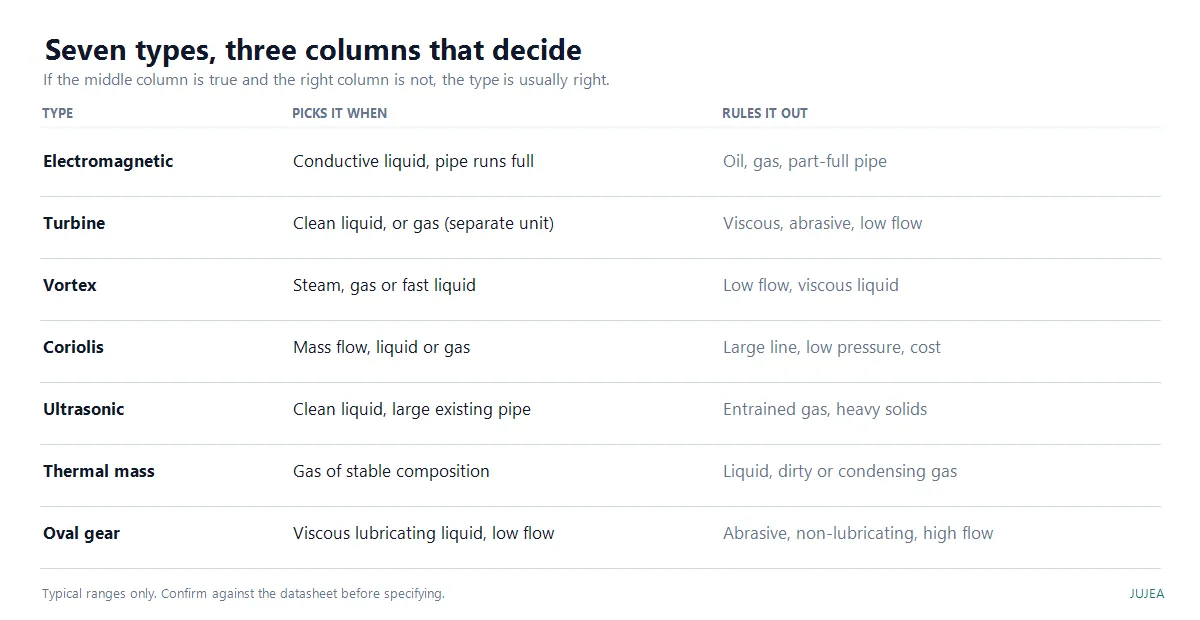
Seven types, three columns — if the middle column is true and the right one is not, the type is usually right.
Phase coverage is not one-to-one, and there are two different kinds of coverage. Vortex and Coriolis measure both liquid and gas with the same meter, and vortex also covers steam. Turbine is a different case: the principle is shared, but a liquid turbine and a gas turbine are separate products, each calibrated for its own phase at the factory. Electromagnetic, oval gear and ultrasonic transit-time are liquid-only, and thermal mass is gas-only.
When Each Type Is the Right Answer
Electromagnetic: conductive liquid, full pipe
Choose it when the liquid conducts — water, wastewater, slurry, acid, alkali, milk, syrup — and the pipe runs full at the measuring point. It has no moving parts, no pressure-loss penalty worth counting, and it handles solids far better than any mechanical meter.
Avoid it when the fluid is a hydrocarbon, a solvent, a gas or demineralised water, or when conductivity falls below the meter's minimum — typically around 30 µS/cm, though the figure varies with meter design, and high-impedance electromagnetic models can work down to 5–10 µS/cm. Ask for the minimum against your actual fluid rather than treating 30 as a law of physics. It also fails in a gravity line that runs part-full, because the meter measures velocity and multiplies by the pipe area it is told about. If the pipe is not full, the meter is not wrong — the assumption is. Range: electromagnetic flow meters.
The full selection logic — liner, electrode, sizing and grounding — is in how to select an electromagnetic flowmeter. For the two duties that generate the most questions, see wastewater and chemical media.
Turbine: clean liquid or gas, steady flow
Choose it when the fluid is clean, low-viscosity and free of fibres — water, fuel, light hydraulic oil — and the flow stays inside a moderate band. Turbine meters are compact, inexpensive per unit of line size, and available in a wide range of bodies. Liquid service uses the flanged, threaded, clamp, micro and PTFE-lined versions in our range. A gas turbine is not the same product on a different setting: it is a separate body and rotor, calibrated for gas at the factory, and a liquid turbine cannot be re-ranged to measure gas. The name and the principle are shared; the product is not.
Avoid it when the fluid is abrasive or pulsating, or viscous beyond the model's viscosity curve, or when the minimum flow matters more than the maximum. Light oil at line temperature stays inside that curve; a thick grade in a cold line does not. The rotor rides on bearings: solids shorten their life, and viscosity slows the rotor until the reading stops tracking the flow. A turbine also needs straight run, and it does not tolerate being asked to measure a flow that starts and stops all day. Range: turbine flow meters.
Vortex: steam, gas and clean liquids
Choose it when you are measuring steam, gas or a clean low-viscosity liquid at a velocity high enough to shed vortices reliably. It is one of the few principles that covers all three phases with the same body, and it has no moving parts, so it suits steam headers, compressed air and fast liquid lines alike. Vortex meters tolerate temperature and pressure well and are common on steam headers and compressed-air lines.
Avoid it when the flow drops below the meter's minimum Reynolds number. At low flow the vortex signal simply disappears — the meter is not broken, it is below its operating envelope. Vortex is also a poor fit for viscous liquids and for processes that swing across a very wide range. Range: vortex flow meters.
Coriolis: mass flow, both phases, at a price
Choose it when the number that matters is mass, not volume — custody transfer, additive dosing, recipe batching, density-sensitive products — or when the fluid's conductivity and viscosity rule out the simpler options. A Coriolis meter measures mass directly, reports density alongside it, and does not care whether the fluid is a liquid or a gas.
Avoid it when the line is large, the pressure is low, or the budget is fixed. The measuring tubes are the restriction: the meter adds pressure drop, it is practical only up to moderate line sizes, and it costs several times what an electromagnetic or turbine meter costs at the same bore. Two-phase flow — entrained gas in a liquid, or liquid slugs in a gas — also disturbs the vibration and is the classic Coriolis failure mode. Range: Coriolis flow meters.
Ultrasonic: clean liquid, large pipe, retrofit
Choose it when the pipe is already installed and you cannot cut it, the line size is large, or the fluid is clean enough for sound to cross it. Clamp-on units are also useful for verification: comparing a fixed meter against a portable ultrasonic is a practical way to confirm a suspect reading without breaking the line.
Avoid it when the acoustic path is broken rather than merely dirty: a section running part-full with an air pocket at the transducer, heavy internal scaling or a loose liner, or a solids load high enough to scatter most of the beam. Transit-time measurement times a pulse across the pipe, so anything that reflects, refracts or absorbs that pulse changes the answer.
How much gas or solids is too much deserves a precise answer, because the failure is not a switch. A modest fraction of entrained gas or fine particles does not stop a transit-time meter — it weakens the signal and biases the reading, and the bias grows as the fraction rises. Drift comes first: the meter still displays a number, a few percent off, and nothing looks wrong. Loss of signal comes second: past the model's limit the receiver can no longer separate the pulse and the output falls to zero, holds its last value, or raises an alarm. Most clamp-on transmitters report signal strength or SNR, and that figure is the honest answer for the installed point — high and stable means the reading holds within its stated accuracy; marginal means it does not. Ask the supplier for the model's entrained-gas and solids limit instead of assuming a clean-liquid meter fails at the first bubble. Range: ultrasonic flow meters.
Thermal mass: gas only
Choose it when you need mass flow of a known gas — compressed air, nitrogen, natural gas, burner air — without separate temperature and pressure compensation. Insertion versions suit large ducts and stacks; inline versions suit small lines.
Avoid it when the gas composition changes, the gas is dirty or condensing, or the fluid is a liquid. Thermal meters infer mass flow from heat transfer, so a change in composition or a coating on the sensor changes the calibration. Range: thermal gas mass flow meters.
Oval gear: viscous liquid, low flow
Choose it when the liquid is viscous and lubricating — hydraulic oil, fuel, resin, syrup, additive dosing — and the flow is low but must be measured accurately. Positive displacement gives a direct volumetric count with very good repeatability at small volumes, and viscosity helps it: a thicker oil seals the gaps between gear and body, so slip falls and the low-flow reading holds up. The circular gear meter is the same family at a smaller scale, built for millilitre-rate lubrication and test-bench lines.
Avoid it when the fluid carries abrasive particles or does not lubricate, and when the flow is high enough that pressure drop becomes a process problem. Gear meters are also unforgiving of dry running and of pressure spikes from a fast-closing valve. Range: oval gear flow meters, circular gear flow meters.
Six Duties and the Type That Fits
Duty | Best first choice | Why | Second option |
Municipal wastewater, DN600 | Electromagnetic | Conductive, abrasive, wide range, no moving parts | Ultrasonic (insertion) |
Clean water transfer, DN50 | Turbine or electromagnetic | Both accurate; turbine is cheaper, EM tolerates debris | Oval gear for small volumes |
Saturated steam header | Vortex | No moving parts, tolerates temperature | Orifice with compensation |
Compressed air main | Thermal mass | Direct mass flow, low pressure loss | Vortex at high velocity |
Hydraulic oil dosing, recipe accuracy critical | Coriolis | Mass-based dosing, density available, no viscosity limit | Oval gear |
Existing DN800 raw water line | Ultrasonic clamp-on | No pipe cutting, no pressure loss | Insertion electromagnetic |
Where Two Types Overlap, and How to Break the Tie
Most real projects come down to two candidates. The ties that recur:
Electromagnetic versus ultrasonic on water. Both handle clean water. Choose electromagnetic when the pipe is full, the fluid is dirty or abrasive, and a spool piece can be installed. Choose ultrasonic when the pipe cannot be opened, the line is very large, or you need a portable check meter.
Turbine versus oval gear on oil. Turbine wins on flow and pressure drop, oval gear wins on viscosity and low-flow accuracy. If the oil is thick and the flow is small, gear. If the oil is thin and the line runs continuously, turbine.
Vortex versus electromagnetic on hot water. Vortex tolerates temperature, but it needs velocity and it loses signal at low flow. Above 100 °C, electromagnetic still wins wherever the liner and electrode are rated for it and the water conducts.
Coriolis versus everything else on mass. If the contract, the recipe or the emissions report is written in mass, Coriolis removes the density assumption that every volumetric meter carries. That is what the price buys — not accuracy for its own sake.
Vortex versus thermal mass on gas. Vortex measures volumetric flow and needs compensation to give mass; thermal mass gives mass directly but needs a stable composition. If the gas is bought and sold by mass or standard volume, thermal mass usually wins the argument. The full logic, including the unit trap that decides most gas sizing, is in how to select a gas flow meter.
Hydraulic Oil: Three Meters Fit, and Viscosity Picks
Hydraulic oil is the case that catches people out, because the reflex answer is the one that cannot work. Oil is a dielectric: there is no signal for an electromagnetic meter to induce, and no liner or electrode choice rescues it. That leaves three instruments from this comparison — turbine, oval gear and circular gear — and all three are volumetric, so the decision turns on viscosity, flow rate and what the reading is used for.
Duty | Best fit | Why it wins | Second choice |
Light oil (ISO VG 32/46), continuous line, moderate to high flow | Turbine | Thin enough for the rotor to track, low pressure drop, simple body | Oval gear |
Heavy or cold oil, low flow, repeatability matters | Oval gear | Viscosity seals the gear clearance, so slip is small and the count is stable | Circular gear |
Millilitre-rate lubrication, leak-off, test-bench dosing | Circular gear | Positive displacement at flows a turbine cannot resolve | Micro turbine |
Dosing where density shifts with temperature | Coriolis | Mass direct, no viscosity limit | Oval gear |
Three things decide between the first three rows.
Calibrate on the oil, not on water. A turbine's K-factor is a function of viscosity. A meter proved on water and then dropped into a hydraulic line will read high or low until it is calibrated on the actual oil at the working temperature. This is the most common error in oil service, and it stays invisible until someone checks the totaliser against a tank.
Viscosity moves the two meters in opposite directions. As the oil thickens, the turbine's rotor lags and its linear band narrows — the low end rises first. The gear meter improves: thicker oil leaks less past the gears, so volumetric efficiency goes up rather than down. That is why a 20 cSt oil and a 200 cSt oil do not get the same recommendation at the same flow.
Air is the failure that looks like success. A volumetric meter cannot tell oil from foam. Air entrained from a low reservoir level, a leaking suction line or a badly bled test bench is counted as oil, and the meter over-reads with no diagnostic flag. If the number matters, bleed the line, keep the suction submerged, and check the totaliser against a known volume.
For pulsation dampers, strainers and bypass legs on a test stand, see hydraulics and pneumatics flow measurement. For the meter families: liquid turbine, oval gear, circular gear, and oil flow meters.
How Installation Changes the Answer
The table above assumes an ideal installation. In practice, four site conditions move the decision:
Can the pipe be opened? A spool-piece meter needs a shutdown, flanges and space. A clamp-on ultrasonic or an insertion meter does not. On a live main, that difference often outweighs a small accuracy advantage.
Is the pipe full? Electromagnetic and ultrasonic transit-time both assume a full bore. In a gravity sewer or a partly filled drain, neither is valid at that point — move the measurement to a rising main or a full section.
Is there straight run? Turbine and vortex are the most sensitive to swirl and to asymmetric velocity profiles; electromagnetic is more forgiving but still wants roughly 5D upstream and 3D downstream. If the only available location is directly after a double bend, the type may have to change even though the fluid suits it.
Is there vibration or electrical noise? Vortex and turbine are mechanical and can pick up vibration; electromagnetic depends on a stable ground reference, so grounding rings or a grounding electrode are not optional. A meter that is correct on paper and ungrounded on site reads noise, not flow.
None of these is a reason to choose a worse principle. They are reasons to check the installation before the purchase order, not after.
What to Put in the RFQ
Fluid name, composition and, for liquids, conductivity
Phase: liquid, gas or steam, with normal and maximum pressure
Operating temperature range, including cleaning cycles
Minimum, normal and maximum flow, in the units you actually use
Line size and schedule, plus whether the pipe can be opened
Solids content, particle size and abrasiveness
Viscosity at operating temperature
Required accuracy and repeatability, and what the reading is used for
Output and protocol: 4–20 mA, pulse, RS485/Modbus RTU, HART
Environment and certification: indoor/outdoor, hazardous area, hygiene
An RFQ that answers these ten gets comparable quotations, and it lets a supplier tell you which of the flow meter types is being ruled out and why. One that says "a flow meter for water, DN50" gets six different guesses.
FAQ
Q: Which flow meter type is the most accurate? A: Coriolis, at roughly ±0.1–0.2% on mass flow. Electromagnetic and oval gear meters follow at about ±0.5%, turbine and vortex around ±1%. Accuracy is still less important than fit: a ±0.5% meter in a half-full pipe is less accurate than a ±1% meter installed correctly.
Q: Can one meter type handle both liquid and gas? A: It depends on the type. Vortex and Coriolis measure both phases with the same meter, and vortex also covers steam. Turbine shares one principle across two separate products — a liquid turbine and a gas turbine, each calibrated for its own phase. Electromagnetic, oval gear and ultrasonic transit-time are liquid-only, and thermal mass is gas-only.
Q: Why not use a turbine everywhere it is cheaper? A: Because bearings wear. A turbine in dirty or abrasive service loses accuracy quietly and then seizes. The saving on the purchase price is usually spent on replacement rotors.
Q: Is a clamp-on ultrasonic as accurate as an inline meter? A: Usually not, and it depends heavily on pipe condition and installation. It is excellent for verification and for lines that cannot be opened, but for billing or control duty an inline meter is the safer choice. Entrainment widens that gap before it ends the measurement: light aeration costs accuracy first, so a clamp-on can read plausibly and still be a few percent out.
Q: When is a vortex meter a bad idea? A: At low flow, with viscous liquids, and on processes that swing across a wide range. Below its minimum Reynolds number the vortex signal disappears and the meter reads zero.
Q: Do electromagnetic flowmeters work on oil? A: No. Oil is non-conductive, so the meter cannot generate a signal. It can measure produced water or oily wastewater where water remains the continuous phase, but not the oil itself.
Q: Which flow meter measures hydraulic oil? A: Turbine, oval gear and circular gear meters all do, because none of them needs the fluid to conduct. Choose by viscosity and flow: a turbine for light oil at moderate to high flow, an oval gear meter for thicker or colder oil at low flow where the count has to be repeatable, and a circular gear meter for millilitre-rate lubrication and test-bench lines. Calibrate on the actual oil at its working temperature — a K-factor proved on water will not transfer.
Q: What decides between insertion and full-bore? A: Line size and whether the pipe can be opened. Insertion types suit large pipes and retrofits; full-bore types give better accuracy and are preferred below roughly DN300.
Q: How much straight pipe does each type need? A: It varies by principle and by upstream disturbance. Electromagnetic typically needs about 5D upstream and 3D downstream; turbine and vortex need more, and after a double bend or a pump the requirement grows. Confirm against the manual rather than assuming a single number.
Q: Can I use the same meter for steam and water? A: No. Steam service needs a meter rated for the temperature and for two-phase risk; a water meter installed on steam will fail quickly.
Q: What is the cheapest way to measure a large existing pipe? A: Usually a clamp-on ultrasonic or an insertion meter, because neither requires cutting the line. The purchase price may be higher than a small inline meter, but the installation cost is far lower.
Next Step
If the fluid is conductive and the pipe runs full, the decision is already made — the remaining work is liner, electrode and sizing, which the selection guide covers step by step. If the fluid is gas, steam, viscous oil or a line you cannot open, send the ten RFQ items above and we will tell you which of the seven types fits, and which ones to rule out.
Talk to our engineers · Browse flow meters
Ethan Liu
Ethan Liu is JUJEA's technical content specialist, translating complex sensor integration and industrial automation concepts into practical insights for engineers, system integrators, procurement professionals, and decision-makers worldwide.


 한국어
 français
 Deutsch
 Español
 italiano
 русский
 português
 العربية
 tiếng việt
 čeština