Chemical duty is a materials problem before it is a flow problem. Two meters with the same DN, the same accuracy class and the same converter can differ by a factor of three in price and by years in service life, because one has a PTFE liner with Hastelloy C electrodes and the other has rubber and 316L. The medium decides the liner, the liner and the medium together decide the electrode, and only then does sizing matter. This guide works through that sequence with the material matrix we use for chemical enquiries.
Short answer: match the liner to the chemistry and temperature first (PTFE for strong acids and bases, FEP for high temperature, FEP or PFA for vacuum, rubber or polyurethane where abrasion dominates), then choose the electrode against the specific ion that attacks it (Hastelloy C for chlorides and HF, titanium for oxidising acids, tantalum for hot strong acids, platinum for fuming acids, tungsten carbide where solids wear the metal). If the chemistry is ambiguous, the meter is not the place to find out. The same sequence applies whether you are replacing an existing chemical flow meter or specifying one for a new line: chemistry, then materials, then size.
Chemical Duty Is a Materials Problem First
An electromagnetic flowmeter has no moving parts and no orifice. What it does have is a wetted liner and two electrodes in direct contact with the process. Every failure mode in chemical service traces back to one of those three surfaces:
Liner permeation. Aggressive species migrate through a liner that is chemically correct but too thin, too hot, or applied over a poor bond. The symptom is a reading that drifts over months, then an earth fault.
Electrode corrosion. The electrode is a small area at high current density. A 316L electrode that is "generally corrosion resistant" will fail in weeks in wet chlorine or hot caustic.
Liner collapse under vacuum. PTFE cold-flows. On a pump suction line or a vessel emptying under vacuum, a PTFE liner can deform and pinch the bore.
Abrasion. Solids in a corrosive slurry attack the liner at the flange face and the electrode tips, which is where the velocity is highest.
The consequence for selection is simple: do not start from the flow rate. Start from a chemical description of the medium, then read the two material tables below, then size the meter.
Step 1: Read the Medium as a Chemical
Before any table lookup, seven facts decide most of the answer:
Concentration, not just the name. "Sulphuric acid" covers 5% and 98%, and they behave like different chemicals. Dilute acid is often more aggressive to metals; concentrated acid is more aggressive to some liners.
Temperature, including cleaning and upset conditions. A CIP cycle at 90 °C can exceed the liner limit even when the process runs at 40 °C.
Oxidising or reducing character. Nitric acid and hypochlorite attack metals by oxidation; hydrochloric acid attacks by chloride pitting. The same alloy rarely handles both.
Chloride content, including trace chlorides. A "dilute acid" stream with 200 ppm chlorides rules out 316L and usually points to Hastelloy C.
Solids and abrasion. A corrosive slurry needs both corrosion resistance and wear resistance, and those two requirements usually conflict.
Aeration, dissolved gas and vacuum. Entrained gas affects the signal; vacuum affects the liner. Both are selection inputs, not installation details.
Oil, if present, and in what form. Free oil, dispersed droplets and a continuous oil phase are three different problems. Electromagnetic measurement needs a continuous conductive phase, which means water must stay continuous — see the FVMQ section below.
Write these six down before you open a catalogue. If any of them is unknown, the honest answer is a sample test or a reference installation, not a guess.
Liner Selection: Five Options
The liner is the largest wetted surface and the first cost driver in any chemical flow meter — the material premium it carries is one of the largest single line items in a quotation, alongside line size and calibration scope. Compare the options on corrosion resistance, abrasion resistance and temperature limit — the three properties that decide service life.
Liner | Corrosion resistance | Abrasion resistance | Temperature | Typical duty |
Rubber (NR / CR / EPDM) | Fair | Good | -20 to 60 °C | Water, tap water, industrial water, cement slurry, paper pulp |
PTFE (F4) | Excellent | Fair | -20 to 120 °C | Concentrated acids and alkalis, organic solvents, high-purity reagents, hygienic service |
FEP (F46) | Excellent | Good | -20 to 180 °C | High-temperature corrosive duty, vibration, vacuum, pump discharge piping |
Polyurethane (PU) | Fair | Excellent | -20 to 80 °C | Mining slurry, mortar and sand slurry, fly-ash slurry, abrasive neutral media |
PFA | Excellent | Moderate | Confirmed per application | Strong corrosion, high cleanliness, permeating media, vacuum duty |
How to read this table.
Rubber is the abrasion default, not the chemical default. CR handles water-based slurries well and costs the least, but it is the wrong choice the moment the medium is a strong oxidiser, a strong solvent, a concentrated acid, or above about 60 °C. EPDM grades extend the ceiling slightly; chloroprene does not. The abrasion logic is the same one that drives wastewater meter selection, where solids rather than chemistry set the specification.
PTFE is the chemical default. It covers most acids, bases and solvents at moderate temperature, which is why it appears in most PTFE-lined flow meters for corrosive duty. Its weakness is mechanical: it cold-flows, so it needs careful backing and is a poor choice on vacuum duty.
FEP is PTFE made practical. It is a melt-processable fluoroplastic: chemical resistance close to PTFE, but tougher, easier to line, and far more forgiving under vacuum and vibration because it bonds to the housing instead of relying on a mechanical fit. Its rated range runs to 180 °C — well above what a PTFE assembly is rated for — because a bonded, melt-processed lining does not depend on a mechanical fit that cold-flows under pressure. That is what makes it the answer where PTFE's mechanics, not its chemistry, are the limit.
PFA is the high-purity, low-permeation option. It is dense and pinhole-free, resists permeation better than PTFE or FEP, and is the most comfortable of the three under vacuum. It costs the most and is chosen where extractables or permeation decide the result. Its temperature range is confirmed per application rather than published as a fixed figure, so do not read the absence of a number as a limit.
PU is for wear, not for chemistry. It outperforms rubber where solids are sharp and the medium is neutral or only mildly corrosive.
A note on the temperature column. These are rated liner temperatures from our own specification. PTFE's 120 °C is deliberately conservative: the material itself withstands more, but cold flow and the pressure/vacuum limits of a lined assembly govern the real ceiling, and competitors often quote the higher material figure instead. Compare the pressure and vacuum conditions behind a number before treating two datasheets as comparable. PFA is deliberately left without a published range in this table: it is specified per application, because permeation and vacuum duty, not temperature alone, decide whether it is the right liner.
FVMQ is not in this table on purpose. It is not a chemistry answer but an oil-in-water answer, and mixing the two logics is how liners get mis-sold. It is covered separately below.
The vacuum rule. If the measuring point can see vacuum — pump suction, vessel drain, siphon — do not specify PTFE alone. Move to FEP or PFA, or confirm with the supplier that the liner is rated for the vacuum level. This is the single most common liner failure we see in chemical plants, and it is invisible in a datasheet that only lists temperature.
Electrode Selection: Seven Options
The electrode is small, exposed and electrically active, which makes it the most corrosion-sensitive part of the meter. If you are still deciding whether electromagnetic measurement suits the duty at all, the liner, electrode and sizing fundamentals are the place to start. Select it against the specific ion, not against a general "corrosion resistance" ranking.
Electrode | Strength | Limitation | Typical duty |
316L stainless steel | Neutral media, weak acids and weak bases | Not for strong acids or strong alkalis | Water, municipal and industrial wastewater, circulating water, neutral food and beverage |
Titanium (Ti) | Excellent corrosion resistance and oxidation resistance | Not for hydrofluoric acid or hot concentrated alkali | Chlor-alkali, hypochlorite, seawater, dilute nitric acid, bleaching in paper and textile |
Tantalum (Ta) | Highest corrosion resistance among the common alloys; withstands strong acids | Highest material cost; specify only where the duty requires it | Strong acids at high temperature, aggressive oxidising media in chemical and petrochemical service |
Hastelloy B / C (HB / HC) | Hydrochloric acid at all concentrations below boiling; sulphuric, phosphoric and hydrofluoric acids; organic acids, alkalis and salts | High cost | Chloride-bearing and mixed-acid duty, pickling lines, flue-gas desulphurisation, wet metallurgy |
Platinum (Pt) | Resists most acids and alkalis, including fuming sulphuric and nitric acid | Soft, poor abrasion resistance | Hot oxidising acids, concentrated oxidising media |
Tungsten carbide (WC) | Highest hardness and wear resistance; resists particle impact and cutting wear | Limited corrosion resistance; neutral to weakly alkaline liquids only | Sand-bearing wastewater, mining and cement slurry, mortar, paper stock |
How to read this table.
316L is the default and the first thing to rule out. It is correct for water-like duty and wrong for almost every chemical enquiry. If the medium contains chlorides, strong acid or strong alkali, 316L is a scheduled failure.
Titanium is for oxidising chemistry. Hypochlorite, chlor-alkali, seawater, dilute nitric acid. It is the wrong answer for hydrofluoric acid and for hot concentrated caustic.
Hastelloy C is the workhorse for chlorides and mixed acids. Hydrochloric acid at any concentration below boiling, sulphuric and phosphoric acid, HF — this is where HC earns its price.
Hastelloy B and C are quoted as HB and HC, and they are not interchangeable. B is for reducing acids such as hydrochloric acid; C adds chromium and molybdenum for oxidising conditions and chloride pitting resistance. Ask which one is being quoted, not just "Hastelloy".
Tantalum and platinum are the last resort, not the premium default. Both are correct answers in narrow conditions — hot strong acid for Ta, hot oxidising acid for Pt — and both are wasted money outside them. Platinum is soft; it will not survive an abrasive duty no matter how good its chemistry.
Tungsten carbide solves wear, not corrosion. It has the highest hardness of the options here and resists particle impact and cutting wear, which makes it the first choice for sand-bearing wastewater and slurry. Its corrosion resistance is weak, so it belongs in neutral or only weakly alkaline media; pairing it with a strong acid is a mistake that shows up as a pitted electrode within months.
When the Medium Contains Oil: Where FVMQ Fits
Oil is not conductive, so an electromagnetic flowmeter cannot measure it. What the meter can measure is water that still forms the continuous phase, with oil dispersed in it as droplets. That distinction decides whether a fluorosilicone (FVMQ) liner is the right answer or a costly mistake.
Three duties that qualify:
Produced water from oilfields — saline, conductive, carrying residual dispersed oil
Oily wastewater from chemical plants, refineries and machine shops — oil-in-water emulsions
Hot or cold oil-in-water emulsions where the water remains continuous across the whole cycle
Three conditions that disqualify the application:
Pure oil, fuel, solvent or any continuous oil phase — there is no conductive path to measure
High free-oil content, or oil that can coat the electrodes — the signal drifts and then disappears
Emulsions that invert to water-in-oil at process temperature
Why FVMQ instead of PTFE for these duties. PTFE resists hydrocarbons chemically, but it is a rigid liner: low-temperature toughness is poor, it has no elasticity, and under repeated hot-cold cycling it can debond or crack. FVMQ is an elastomeric liner — wide service range (about -50 to 175 °C as specified), it conforms to the pipe wall, absorbs thermal cycling, and resists hydrocarbon swelling. In oily conductive water, that mechanical behaviour matters more than chemical inertness. The liner itself resists oils and some solvents; the limit is not the rubber but the measurement principle — without a continuous conductive water phase there is nothing for the electrodes to read.
Liner | Hydrocarbon resistance | Temperature behaviour | Best suited to |
FVMQ (fluorosilicone) | Good; resists swelling in dispersed oil | Wide range, keeps elasticity at low temperature | Oily conductive water with hot-cold cycling |
FKM (fluorocarbon) | Very good in moderate-temperature oil service | Poor low-temperature flexibility; higher cost | Warm oily water without wide thermal swings |
PTFE | Chemically inert to hydrocarbons | Rigid; poor low-temperature toughness; no elasticity | Aggressive chemistry, not thermal cycling |
Selection warning. An FVMQ liner does not make an electromagnetic flowmeter suitable for pure oil or a continuous oil phase. If free oil is high, or if oil can film the electrodes, specify a Coriolis mass meter or an ultrasonic meter instead. The liner protects the meter from swelling; it cannot create a conductive liquid where none exists.
Four Combinations That Cover Most Chemical Enquiries
Most chemical enquiries collapse into one of four material pairs. Use these as starting points, then verify against the concentration, temperature and trace components.
Duty | Liner | Electrode | Why this pair |
Strong acid, ambient to moderate temperature, low solids (e.g. HCl or H₂SO₄ at 20–60 °C) | PTFE | Hastelloy C | PTFE carries the chemistry; HC handles chlorides and mixed acids without the cost of tantalum |
Strong acid at high temperature, or oxidising acid | FEP or PFA | Tantalum, or platinum for fuming/oxidising duty | The liner must hold at temperature; Ta or Pt carries the electrochemical load |
Strong alkali, including hot caustic | PTFE | Hastelloy C, or platinum for the most aggressive duty | Avoid titanium and tantalum, which are attacked by hot concentrated alkali |
Corrosive slurry with high solids | PTFE, or PU where chemistry allows | Tungsten carbide for wear, Hastelloy C for chemistry | Decide which failure mode kills the meter first — abrasion or corrosion |
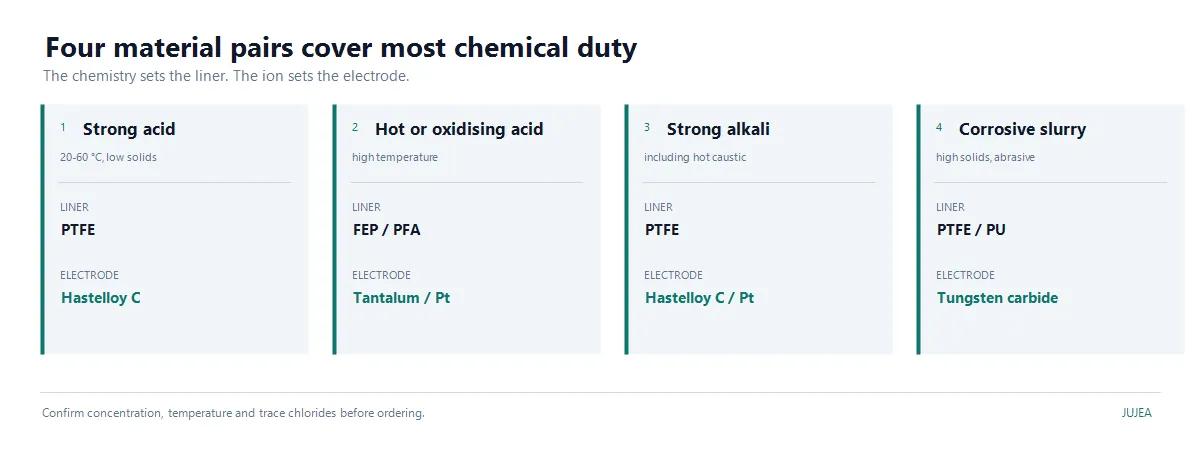
Four material pairs cover most chemical enquiries; the chemistry decides the liner, the ions decide the electrode.
Two rules of thumb that save most projects:
When corrosion and abrasion conflict, decide which one is fatal. A worn electrode drifts and can be replaced; a perforated liner puts the process into the electronics. If both are severe, the application may need a different measuring principle rather than a more expensive meter.
Do not mix a premium electrode with a base liner. A tantalum electrode behind a rubber liner is a quotation error: the liner will fail first and the electrode premium is wasted.
Limits That Override the Material Choice
Materials are necessary but not sufficient. Three process conditions can invalidate an otherwise correct selection:
Temperature at the seal, not at the display. The liner limit applies to the wetted surface. A meter installed close to a hot reactor sees the process temperature even when the ambient is cool; a meter on a line that is steam-cleaned sees 120 °C several times a week. State both the continuous and the cleaning temperature in the enquiry.
Vacuum and negative pressure. As above: PTFE cold-flows. Vacuum duty belongs to FEP or PFA, or to a liner the supplier has explicitly rated for the vacuum level.
Conductivity. Electromagnetic measurement needs a conductive liquid — the practical floor is around 30 µS/cm, well below most aqueous chemical streams but above pure solvents, demineralised water and many organic liquids. If the medium is a solvent or a high-purity organic, this principle may not apply at all, and no amount of liner specification will fix it.
Grounding and Installation in Chemical Plants
Chemical installations fail at the ground as often as at the electrode. Three practices matter:
Use grounding rings or a grounding electrode on lined pipes. The liner insulates the liquid from the pipe, so the pipe cannot serve as the reference. Grounding rings at both flanges are the standard solution; a third electrode is an alternative.
Keep the ground impedance low and single-point. A chemical plant's structure ground is not automatically a clean instrument ground. Verify the resistance at commissioning and record it.
Keep the electrodes wet and the pipe full. Chemical dosing lines often run partly empty between batches. Mount the meter where it stays full — a vertical rising section with upward flow is the safest position — and enable empty-pipe detection so the output is flagged rather than trusted.
The RFQ Data Sheet for Chemical Media
Send these eleven items and a supplier can quote a defensible configuration for a chemical flow meter instead of a guess:
Medium name, concentration range and any trace components (chlorides, fluorides, oxidisers)
Continuous temperature, cleaning temperature and cleaning frequency
Minimum, normal and maximum flow rate, plus the pipe size
Solids content, particle size and abrasiveness
Pressure and whether vacuum can occur
Oil content and form, if any: free oil, dispersed droplets, or continuous phase
Conductivity, if known
Required liner and electrode, if already specified by your process team
Required output: 4–20 mA, pulse, RS485/Modbus RTU or HART
Protection class and area classification, with the installation location
Required documentation: material certificates, calibration certificate, pressure-test report
Two of these are routinely omitted and cause most re-quotes: trace chlorides and cleaning temperature. Both change the material pair, and neither appears on a P&ID.
FAQ
Q: Can an electromagnetic flowmeter measure hydrochloric acid? A: Yes, with the right pair. PTFE or FEP liner with Hastelloy C electrodes is the standard configuration for HCl at all concentrations below boiling. 316L is not suitable, and titanium is attacked by chlorides in reducing acid conditions.
Q: Which electrode is suitable for hydrofluoric acid? A: Hastelloy C is the usual choice for HF, together with a PTFE or PFA liner. Titanium is not suitable, and tantalum should not be assumed — verify the concentration and temperature with the supplier before ordering.
Q: Is PTFE suitable for hot caustic soda? A: PTFE handles the chemistry, but the temperature limit matters: the liner is rated to about 120 °C, and hot concentrated caustic also rules out titanium and tantalum electrodes. Above that temperature, FEP or PFA is the liner to discuss.
Q: Why not use 316L electrodes for every water-based chemical? A: Because 316L fails quickly in chlorides, strong acids and strong alkalis. It is the correct default for neutral water-like duty and the most common cause of premature electrode failure when it is carried into chemical service to save cost.
Q: What is the difference between Hastelloy B and Hastelloy C? A: B is intended for reducing acids such as hydrochloric acid; C adds chromium and molybdenum for oxidising conditions and chloride pitting resistance. They are not interchangeable, and a quotation should state which alloy is offered.
Q: Can I use a rubber liner for an acid slurry? A: Only if the acid is weak and the temperature is below about 60 °C. Rubber is chosen for abrasion resistance, not chemical resistance; in a strong acid it will be attacked at the flange face and around the electrodes.
Q: Does a PTFE liner work under vacuum? A: Not reliably. PTFE cold-flows under vacuum and can deform into the bore. For vacuum or negative-pressure duty, specify FEP or PFA, or confirm the vacuum rating with the supplier in writing.
Q: What conductivity does the medium need? A: Around 30 µS/cm in practice. Most aqueous acids, alkalis and salt solutions are far above this; pure solvents, demineralised water and many organic liquids are below it and cannot be measured electromagnetically.
Q: Can an electromagnetic flowmeter measure oil? A: No. Oil is non-conductive, so the meter needs water to remain the continuous phase. It can measure produced water, oily wastewater and oil-in-water emulsions where oil is dispersed as droplets, but not pure oil or a continuous oil phase.
Q: What is the difference between FVMQ and FKM liners? A: FVMQ (fluorosilicone) keeps elasticity over a wide temperature range and resists hydrocarbon swelling, which suits oily water with hot-cold cycling. FKM (fluorocarbon) has stronger oil and chemical resistance at moderate temperature but poor low-temperature flexibility. PTFE is chemically inert but rigid.
Next Step
If you are specifying a chemical flow meter, send the eleven items above with the concentration and temperature range. Our engineers will return a liner and electrode pair with the reasoning stated, plus the documentation scope — so the quotation can be compared with others on the same basis rather than on price alone.
Send your medium data · Browse JUJEA electromagnetic flowmeters
JUJEA electromagnetic flowmeters are produced in an ISO 9001/14001/45001 factory with CE/RoHS/TUV/SGS certification, individually calibrated on an in-house weighing-method rig, 72-hour burn-in tested, and covered by an 18-month warranty. Material selections in this article follow the JUJEA liner and electrode selection guide; final selection should be confirmed against the actual concentration, temperature and trace components of the process.
Ethan Liu
Ethan Liu is JUJEA's technical content specialist, translating complex sensor integration and industrial automation concepts into practical insights for engineers, system integrators, procurement professionals, and decision-makers worldwide.


 한국어
 français
 Deutsch
 Español
 italiano
 русский
 português
 العربية
 tiếng việt
 čeština