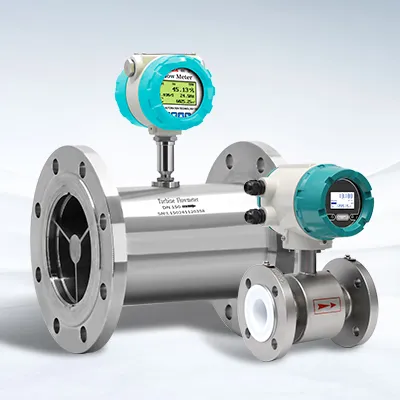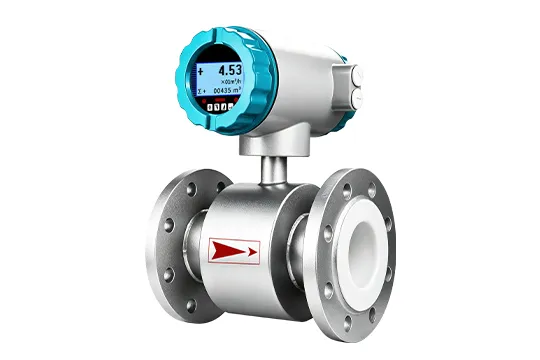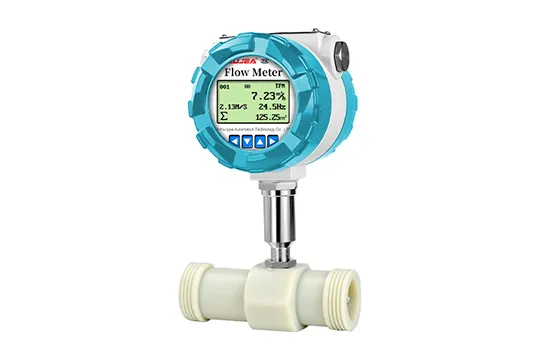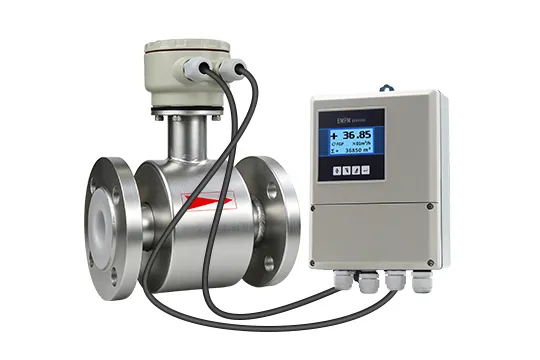
Gas is a harder measurement than liquid, and not because the meters are worse. It is harder because a gas volume means nothing until you say at what temperature and pressure it was measured. Two engineers can quote the same 100 m³/h and be describing flows that differ by a factor of four. This guide starts with that unit problem, then applies five process facts to the five gas meter types we build, and ends with the RFQ items that keep a quote from being built on the wrong number.
Short answer: clean dry gas on a steady line with adequate velocity goes to a vortex; gas where you need mass and a wide turndown at low velocity goes to a thermal mass meter; high-pressure clean gas bought and sold by volume goes to a gas turbine; low-pressure distribution and burner gas goes to a precession vortex; and high-value gas, density-critical duty or two-phase risk goes to Coriolis. Steam is not gas — it is covered at the end, because it breaks most of these rules.
Start With the Unit, Not the Meter
Every gas meter measures one of three things, and most sizing errors come from confusing them:
Actual volume (m³/h, sometimes Am³/h). The volume at the pipe's real temperature and pressure. This is what the meter's body actually sees, and what its velocity range is written in.
Standard or normal volume (Nm³/h, Sm³/h). The same mass, expressed as the volume it would occupy at a defined reference — commonly 0 °C and 101.325 kPa, but 15 °C, 20 °C and 60 °F are all in use. The number is meaningless unless the reference is stated.
Mass (kg/h). No reference conditions needed, which is why contracts that care about energy content often move to mass or to energy units.
Converting between them is not decoration:
Q_normal = Q_actual × (P_actual / P_normal) × (T_normal / T_actual) × (Z_normal / Z_actual)
where pressures are absolute and temperatures are kelvin. At modest pressures the compressibility ratio is close to 1 and can be ignored; at high pressure it cannot.
A worked example. 100 Nm³/h of natural gas at 0.3 MPa gauge and 20 °C:
The meter sees 27 m³/h, not 100. Size a DN50 vortex for 100 m³/h actual and its usable band might run 7–100 m³/h — the real flow sits at the bottom of the linear range, and the night-time minimum, when the line drops to 10 Nm³/h, becomes 2.7 m³/h and falls off the meter entirely. The meter is not faulty. It was bought against the wrong number.
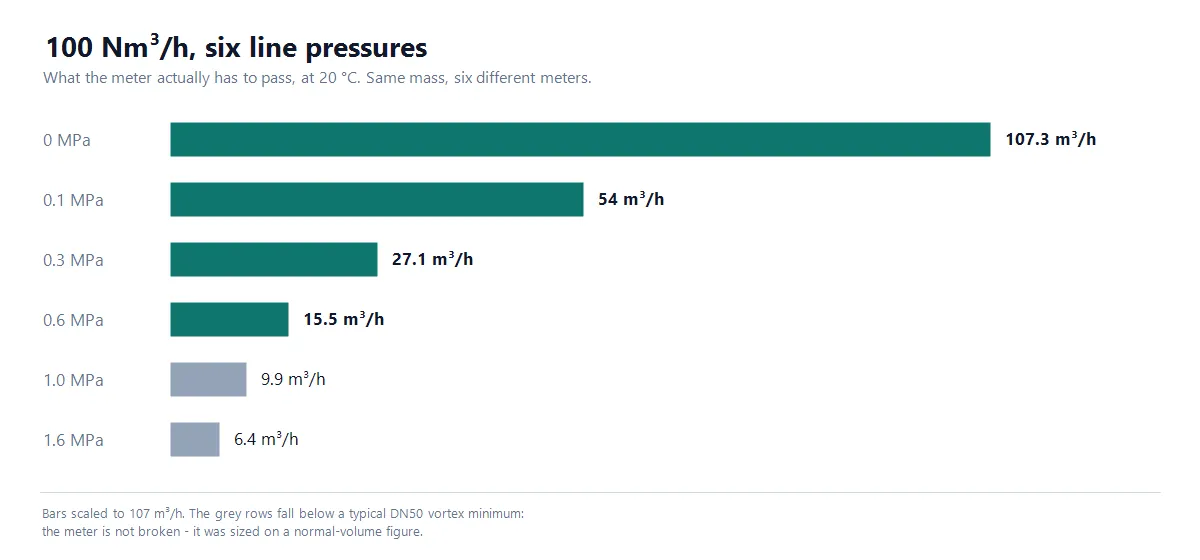
The collapse with pressure is steep, which is why the same nominal flow needs a different meter at a different pressure. 100 Nm³/h at 20 °C, expressed as the actual volume a meter has to pass:
Gauge pressure | Actual flow the meter sees | What it does to a vortex sized for 0.1 MPa |
0 MPa | 107 m³/h | At the top of the band |
0.1 MPa | 54 m³/h | Comfortable |
0.3 MPa | 27 m³/h | Lower half of the band |
0.6 MPa | 16 m³/h | Near the floor |
1.0 MPa | 9.9 m³/h | Usually below minimum |
1.6 MPa | 6.4 m³/h | Below minimum — reads zero |
Same mass, same contract number, six different meters.
Two consequences follow, and they are the reason this section comes first:
Ask what the meter outputs. A vortex outputs actual volume and needs external compensation to give you Nm³/h. A thermal mass meter outputs mass. Our gas turbine and precession vortex meters carry built-in temperature and pressure compensation and can output standard volume directly. Mixing these up in a comparison table is how two "equivalent" quotes end up 30% apart.
Do every sizing calculation in one unit system. Convert the customer's Nm³/h to actual m³/h at the working pressure before you open a datasheet, and convert the meter's range back the same way before you believe it.
Knowing which of those three numbers a meter gives you without extra hardware prevents most comparison mistakes:
Type | What it outputs as supplied | For Nm³/h | For kg/h |
Vortex | Actual m³/h | External pressure and temperature compensation | Compensation plus density |
Thermal mass | Mass, or volume normalised in the meter | Reference conditions entered in the meter | Nothing — mass is native |
Gas turbine | Actual m³/h; compensated models output Nm³/h | Built in on compensated models | Density required |
Precession vortex | Nm³/h with built-in compensation | Built in | Density required |
Coriolis | Mass, density and temperature | Convert with measured density | Nothing — mass is native |
The Five Process Facts That Pick the Gas Meter
1. Is the gas clean and dry? Liquid droplets, oil carry-over and dust are the fastest way to lose a gas measurement. Thermal mass elements coat and drift. Vortex bluff bodies collect debris and change their own shedding frequency. Turbine bearings wear and then seize. Only Coriolis and variable-area meters tolerate much contamination, and even they prefer clean gas.
2. Is the composition stable? A thermal mass meter infers mass from heat carried away, which depends on the specific heat of the gas. Change the CO₂, the moisture or the hydrogen fraction and the calibration moves. A vortex and a turbine are volumetric and largely blind to composition — but then their standard-volume output depends on the density you feed the compensation, which comes from composition.
3. How wide is the real flow range? Not the design maximum — the range between the night minimum and the peak. Gas lines swing more than liquid lines because pressure and demand both move. Thermal mass meters hold a very wide turndown at low velocity; vortex and turbine are narrower and both have a floor below which they read zero rather than read wrong.
4. What pressure and line size? This is the fact most often skipped. At high pressure the actual volumetric flow is small for a given mass, so velocity falls and a vortex or turbine can drop below its minimum. At low pressure the volume is large and the velocity is high — good for vortex, but the pressure loss matters. Large ducts and stacks usually want an insertion meter rather than a full-bore one.
5. Do you need volume or mass — and is it steam? If the commercial or reporting unit is mass or energy, start with a meter that measures mass. If the medium is steam, stop here: most gas meters cannot do it, and the section on steam later explains which can.
The Comparison Table
Type | Principle | Best for | Fails when | Typical accuracy | Turndown |
Vortex | Frequency of vortices shed behind a bluff body | Steam, compressed air, stable gas at adequate velocity | Low velocity, low pressure, pulsating flow, wet gas | ±1.5% | 1:15 |
Thermal mass | Heat carried away by the gas stream | Clean gas, mass flow, wide turndown, large ducts | Composition changes, condensation, coating, steam | ±1–2% | Very wide |
Gas turbine | Rotor speed proportional to velocity | Clean dry high-pressure gas, volume trade | Wet or dirty gas, low flow, pressure swings | ±1% | Moderate |
Precession vortex | Frequency of a precessing swirl in a shaped chamber | Low-pressure distribution gas, burner lines | Very low flow, pulsation, dirty gas | ±1–1.5% | Moderate |
Coriolis | Vibration of a measuring tube, read as mass | High-value gas, density-critical duty, two-phase risk | Large line sizes, low pressure, tight budget | ±0.2% liquid, ask for gas | Very wide |
Variable area (rotameter) | Float height in a tapered tube | Purge lines, local indication, utilities | Remote output, changing T/P, dirty gas | ±1.5–2.5% FS | 1:10 |
Read the table as a shortlist, not a specification. Accuracy, turndown and failure modes are typical values for each class of meter at reference conditions; the installed number depends on the model, the medium and the installation, and has to be confirmed against the datasheet for your duty.
One flow, three units. The meter is chosen in actual volume; the contract is written in standard volume or mass; the conversion between them is where sizing errors are born.
When Each Type Is the Right Answer
Vortex: the default for clean gas at velocity
Choose it when the gas is clean and dry, the velocity stays above the meter's floor across the whole operating range, and the line is DN15 to DN300. Vortex meters have no moving parts, tolerate temperature well, and cover saturated and superheated steam with the same body — which is why they sit on so many steam and compressed-air headers. Our range holds a 1:15 turndown at ±1.5%.
Avoid it when the pressure is high and the flow is small. This is counter-intuitive and it costs people money: at 1.6 MPa a gas that occupies 100 Nm³/h in the contract occupies roughly 6 m³/h in the pipe, and a vortex sized for the low-pressure case will sit under its minimum. Vortex also dislikes pulsating flow from a reciprocating compressor and vibration from nearby machinery, both of which inject noise into the shedding signal.
The sizing question that matters: what is the actual volumetric flow at minimum, and what is the meter's velocity floor at that same pressure? If those two numbers cross, vortex is the wrong choice regardless of how well it fits at maximum.
Thermal mass: mass flow without compensation
Choose it when you need mass flow of a known, clean gas and you want it without a separate temperature and pressure transmitter. A thermal mass meter heats a sensor and reads how much heat the gas carries away; the result is mass, not volume, so it needs no compensation to be correct in kg/h. It also holds a very wide turndown at low velocity, which suits stack gas, vent lines and large ducts where a full-bore meter would be enormous.
Avoid it when the gas composition moves, the gas carries moisture or oil aerosol, or the sensor can coat. Every one of those changes the heat transfer without changing the flow. A thermal mass meter is calibrated for a gas; it is not a universal gas meter. There is a range here worth knowing: high-end transmitters support multi-gas selection or accept an external composition signal and correct online, while low-cost models are fixed-calibrated for a single gas and will not follow a blend. It also cannot measure steam.
The installation question that matters: insertion or inline? Insertion units go into existing large ducts without cutting, but the insertion depth and the flow profile decide the reading — a probe sitting at the wrong depth in a large duct can be 20% off while looking perfectly installed.
Gas turbine: volume trade on clean, high-pressure gas
Choose it when the gas is clean, dry, at pressure, and the reading is used for volume trade or totalising. A gas turbine is a different product from a liquid turbine — different body, different rotor, calibrated for gas at the factory — and our gas units carry built-in temperature and pressure compensation so they can output standard volume directly rather than raw working-condition volume.
Avoid it when the gas is wet, dirty or likely to carry liquid slugs, or when the flow drops low enough that the rotor stops tracking. Bearings wear quietly: the meter keeps reading, slightly wrong, long before it fails. Turbine meters also need straight run and are damaged by overspeed, so a line with a fast-acting valve upstream needs a look before the meter is specified.
The calibration question that matters: at what pressure and with which gas was it proved? A turbine's K-factor is tied to the medium it was calibrated on, and a certificate from air does not transfer to natural gas at 1.6 MPa without correction.
Precession vortex: low-pressure distribution gas
Choose it when the line is low pressure — city gas, burner supply, small distribution stations — and the flow range is moderate. A precession vortex forces the gas into a swirl that precesses at a frequency proportional to flow; there are no moving parts, and the shaped chamber keeps the signal usable at lower velocities than a plain vortex. Ours include Pt100 temperature and pressure sensors with automatic compensation, so the output tracks changing conditions rather than drifting with them.
Avoid it when the flow can fall very low, when the gas is dirty, or when pressure loss is expensive. The shaped chamber costs pressure, and on a low-pressure line that loss is a real operating cost, not a datasheet line.
What it gives back: a much shorter straight run than a vortex — roughly 5D upstream and 3D downstream, against 15–20D and 5D for a vortex. On a crowded distribution station or a skid built to the millimetre, that difference often decides the choice on its own.
Coriolis: mass, density and no assumptions
Choose it when the gas is high-value, the reading has to be mass, or density itself is part of the measurement. A Coriolis meter measures mass directly and reports density and temperature alongside it, so a change in composition shows up as a density change instead of silently corrupting the flow. It also tolerates two-phase flow better than any volumetric meter, which matters on lines that can slug.
Avoid it when the line is large, the pressure is low, or the budget is fixed. Measuring tubes restrict the flow, so pressure drop and line size are the binding constraints; and a Coriolis meter on gas is not automatically as accurate as the same meter on liquid. Ask for the gas accuracy figure specifically, not the headline number from the liquid datasheet.
Variable area: the honest utility answer
Choose it when you need local indication on a purge line, a small utility branch, or a point where nobody will ever wire a signal. A rotameter is cheap, needs no power, and reads instantly.
Avoid it when the number has to stand up as a billing figure. A 4–20 mA remote output is available on metal tube rotameters, so the question is not whether it can be recorded, it is the error. Float height depends on density, so a change in pressure or temperature changes the reading, and the accuracy is a percentage of full scale rather than of reading — at 30% of scale, a ±2% FS meter is really ±6.7% of the value it shows. Range: metal tube rotameters.
Six Gas Duties and the Meter That Fits
Duty | Best fit | Why | Second choice |
Compressed air header, DN80, 0.7 MPa, steady | Vortex | Clean, dry, velocity stable, no moving parts | Thermal mass (insertion) |
Boiler gas supply, billed in Nm³ | Gas turbine with compensation | Clean high-pressure gas, standard volume output | Precession vortex |
City gas at 3 kPa, distribution station | Precession vortex | Low-pressure compensation built in, no moving parts | Rotary/roots (outside our range) |
Flue gas in a large duct, 180 °C, slightly dusty | Thermal mass (insertion) | Wide turndown at low velocity, installs without cutting | Pitot or ultrasonic (outside our range) |
Nitrogen purge, 0.5 Nm³/h | Thermal mass (micro bore) | Mass direct at very low flow | Rotameter |
High-value gas, density check required | Coriolis | Mass and density in one device | Gas turbine plus analyser |
The two rows that catch people are the first and the third, and both are pressure stories. The compressed-air header looks easy and usually is — until the compressor unloads and the flow drops to a fifth of design, where a badly sized vortex reads zero. The city-gas line looks easy and is not, because at 3 kPa there is almost no pressure to spend on a measuring element, and every point of pressure loss is paid for continuously.
Where Two Types Overlap, and How to Break the Tie
Vortex versus thermal mass on compressed air. Both are clean-gas meters. Choose vortex when the line pressure is stable, the flow stays in band, and you want no sensor in the stream that can coat. Choose thermal mass when the flow swings widely, when you want mass without a second transmitter, or when the pipe is large enough that insertion beats a spool piece. The tie-breaker is the minimum flow, not the maximum.
Gas turbine versus precession vortex on natural gas. Both can output standard volume with built-in compensation. Turbine wins where pressure is high, flow is steady and the accuracy requirement is tight. Precession vortex wins where pressure is low, the line is a distribution branch, and there is no room for a rotor that wears.
Thermal mass versus Coriolis when composition drifts. If the gas is a known mixture that varies little, thermal mass is the cheaper mass meter. If the variation is the point — biogas, flare gas, hydrogen blends — Coriolis is the one that can tell you the density changed instead of quietly reinterpreting the flow.
Vortex versus orifice plate. Orifice plates are still everywhere and still cheap to buy, expensive to own: permanent pressure loss, square-root turndown of about 3:1, and an accuracy that depends on sharp edges staying sharp. If a line already has a plate and the range is narrow, replacing it may not pay; if the range is wide or the energy bill matters, a vortex or thermal mass meter usually wins on total cost.
Steam Is Not a Gas
Steam breaks most of the rules above, and it deserves its own sentence rather than a row in a table:
Thermal mass meters cannot measure steam. The sensor would be measuring a condensing two-phase medium, and the calibration has no meaning.
Turbine meters cannot measure steam. Wet steam destroys bearings, and superheated steam at temperature is outside the bearing and seal materials.
Vortex meters can, because the shedding frequency does not care whether the medium is gas or vapour — but only if the body is rated for the temperature and pressure, and only if the steam is dry enough. Wet steam gives a reading that drifts as the dryness fraction changes.
Differential pressure remains the traditional answer for large steam mains, at the cost of permanent pressure loss.
For saturated steam, the practical requirement is temperature and pressure compensation, because the density you need for mass flow is a function of both — and on saturated steam they are not independent, which is exactly why a compensated vortex is the usual choice. Range: steam flow meters. For dryness, compensation and velocity sizing, see how to select a steam flow meter.
Installation Details That Change the Reading
Gas meters are more sensitive to installation than liquid meters, because the medium is compressible and a small pressure disturbance moves a large volume.
Straight run. A vortex typically needs 15–20 diameters upstream and 5 downstream, and more after a double bend, a partly closed valve or a compressor. A precession vortex needs far less — about 5 upstream and 3 downstream — which is why it turns up on skids where a vortex would not fit. A gas turbine wants about 10 upstream and 5 downstream. A thermal mass insertion probe needs enough upstream length for the profile to settle plus a depth that puts the sensor at the right point in the duct — follow the manual for the specific probe, because insertion rules differ by design. Coriolis needs no straight run at all, which is why it appears on skids where space is gone.
Condensate. Any gas line that can drop below its dew point will collect liquid at a low point, and a meter sitting in that liquid reads nonsense. Slope the line, put a trap or knock-out drum upstream, and never install a thermal mass or vortex meter at the bottom of a drip leg.
Pulsation. A reciprocating compressor produces a flow that oscillates around the mean. Volumetric meters integrate that oscillation into a plausible but wrong number, and positive displacement meters can be damaged by it. A pulsation dampener or a sufficient length of pipe between compressor and meter is cheaper than replacing a rotor.
Vibration. Vortex meters detect a frequency, so external vibration is signal noise. Mount them away from pumps and compressors, and use the low-flow cut-off setting rather than expecting the signal processing to sort it out.
Compensation. If the output has to be standard volume or mass, either buy a meter with compensation built in — as our gas turbine and precession vortex units do — or provide pressure and temperature inputs and do the conversion in the flow computer. Doing neither leaves you with a working-condition volume that quietly changes meaning every time the line pressure moves.
What to Put in the RFQ
Send these ten items and a supplier can size the meter instead of guessing:
Gas name and composition, or the expected range if it varies
The unit of the flow you are quoting, and the reference conditions if it is Nm³/h or Sm³/h
Minimum, normal and maximum flow
Operating pressure (state gauge or absolute) and temperature range
Line size, schedule and material
Straight run available upstream and downstream, and whether the pipe runs horizontally or vertically
Moisture, condensate, dust and oil content
Hazardous area classification, and the ingress protection required
Output and protocol — 4–20 mA, pulse, RS485/Modbus, HART — and the available power supply
Whether the reading drives billing, custody transfer or a compliance report, because that decides the calibration certificate
Item 2 is the one that gets skipped, and it is the one that changes the answer. A supplier who quotes without asking it is quoting a meter, not a measurement.
FAQ
Q: How do I convert Nm³/h to m³/h? A: Multiply by the pressure ratio and the temperature ratio: Q_a = Q_N × (P_N / P_a) × (T_a / T_N), with absolute pressures and kelvin. At 0.3 MPa gauge and 20 °C, 100 Nm³/h is about 27 m³/h actual. Do this before comparing any meter's range to the process.
Q: Can one gas meter measure both gas and liquid? A: Vortex and Coriolis can, with the same body, because their principles do not depend on the phase. A turbine cannot: a liquid turbine and a gas turbine are separate products with different rotors, each calibrated for its own medium at the factory.
Q: Which flow meter should I use for compressed air? A: Vortex for a steady header with stable pressure; thermal mass when the flow swings widely or the pipe is large enough that insertion is easier than a spool piece. Check the minimum flow at the lowest pressure the compressor will run at, not at the design point.
Q: Why does my vortex meter read zero at night? A: Because the actual volumetric flow fell below the meter's minimum velocity. Pressure changes move the actual volume much more than they move the mass, so a line that is comfortable at peak can be under the floor at minimum. The fix is either a smaller bore, a different principle, or accepting a low-flow cut-off.
Q: Is a thermal mass meter better than a vortex for natural gas? A: Only if the composition is stable and the turndown is the problem. Thermal mass gives mass directly and holds a wide turndown at low velocity, but its calibration depends on the gas, and moisture or oil carry-over will coat the sensor. For clean, high-pressure gas traded by volume, a compensated gas turbine is the more conventional choice.
Q: Do I need temperature and pressure compensation? A: If the number you report is standard volume or mass, yes. A volumetric meter at working conditions needs both inputs; thermal mass gives mass without them; our gas turbine and precession vortex meters have compensation built in. Reporting raw m³/h from a line whose pressure moves is reporting a number that changes meaning.
Q: Can a gas flow meter measure steam? A: A vortex can, if the body is rated for the temperature and the steam is dry enough. Thermal mass and turbine meters cannot. For saturated steam, use temperature and pressure compensation, because density depends on both.
Q: Is gas accuracy the same as liquid accuracy? A: Not always. A Coriolis meter quoted at ±0.2% on liquid is usually looser on gas, and the gas figure is the one that applies to your duty. Volumetric gas meters typically land at ±1% to ±1.5%. Ask for the accuracy at your gas, pressure and flow, not the headline.
Q: How much straight pipe does a gas meter need? A: Vortex about 15–20D upstream and 5D downstream; gas turbine about 10D and 5D; thermal mass per the probe manual, plus correct insertion depth; precession vortex about 5D and 3D; Coriolis none. After a double bend, a compressor or a partly closed valve, add length rather than trusting the minimum.
Q: Can I use a liquid turbine to measure gas? A: No. A gas turbine is a different product — different body, different rotor, calibrated for gas at the factory — and a liquid turbine cannot be re-ranged to measure gas. The name and the principle are shared; the meter is not. Range: gas turbine flow meters.
Next Step
If you have the ten RFQ items, send them and we will tell you which of the five gas types fits and which to rule out — including the case where the honest answer is that your flow is too low for any of them at that line size. If you are still deciding whether the medium needs a gas meter at all, start with the seven flow meter types compared, then come back here for sizing.
Talk to our engineers · Browse gas flow meters
Ethan Liu
Ethan Liu is JUJEA's technical content specialist, translating complex sensor integration and industrial automation concepts into practical insights for engineers, system integrators, procurement professionals, and decision-makers worldwide.


 한국어
 français
 Deutsch
 Español
 italiano
 русский
 português
 العربية
 tiếng việt
 čeština