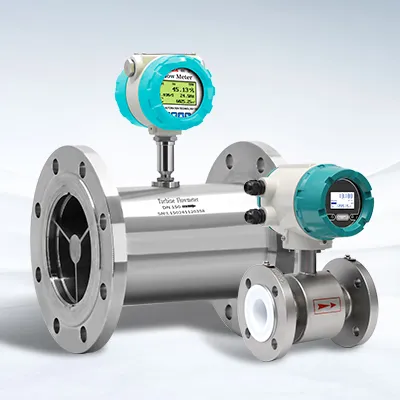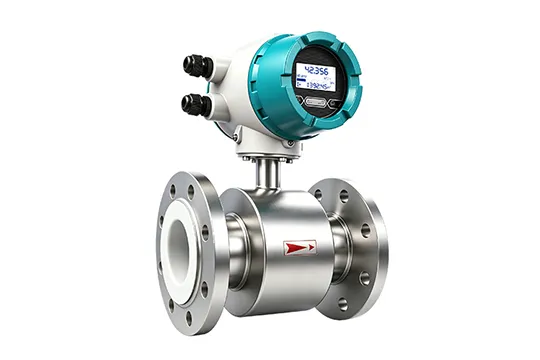
An electromagnetic flowmeter is chosen twice. The first choice is the one in the catalogue: bore, liner, electrode, converter. The second choice is the one the plant makes for you, because the industry decides which of those four matters. A liner that is correct in a chemical plant is a wear part in a mine. An electrode that survives seawater pits in a food line. Same meter family, same datasheet — opposite verdicts.
Short answer: four variables decide more than any datasheet: the conductivity of the medium, the abrasion it carries, the hygiene the process demands, and the corrosion it inflicts. Fix those four and the liner, electrode and body follow. What changes by industry is not the principle — Faraday's law does not care what is in the pipe — it is which of those four variables is the one that will actually stop the meter.
The Four Variables That Outrank the Datasheet
Conductivity decides whether the meter works at all. An electromagnetic meter measures a voltage generated by a conductive liquid crossing a magnetic field. Below roughly 30 µS/cm the signal becomes indistinguishable from noise on a standard converter. High-impedance designs push that floor down to about 5–10 µS/cm, but that is a model specification, not a law of physics — it is a claim the supplier has to support for your medium.
Abrasion decides how long it works. Solids do not just attenuate the signal; they grind the liner and the electrode. This is the variable that separates a five-year installation from an eighteen-month one, and it is almost never in the RFQ.
Hygiene decides whether it is allowed in the line. A dairy cannot install a meter it cannot clean. Surface finish, connection type, dead legs and the certificate that says so are entry requirements, not preferences.
Corrosion decides what it is made of. Acids, chlorides and oxidisers each attack a different material. The correct answer in one duty is the wrong answer in the next.
Variable | What it decides | Where it bites hardest |
Conductivity | Whether the principle applies at all | Demineralised water, condensate, solvents, edible oil, concentrated syrup |
Abrasion | Liner life, electrode life, calibration drift | Mining slurry, pulp stock, FGD limestone slurry, sand-bearing wastewater |
Hygiene | Connection, finish, cleanability, certification | Dairy, beverage, pharmaceutical, CIP circuits |
Corrosion | Liner and electrode material | Chemical, chlorinated water, seawater, bleach plant |
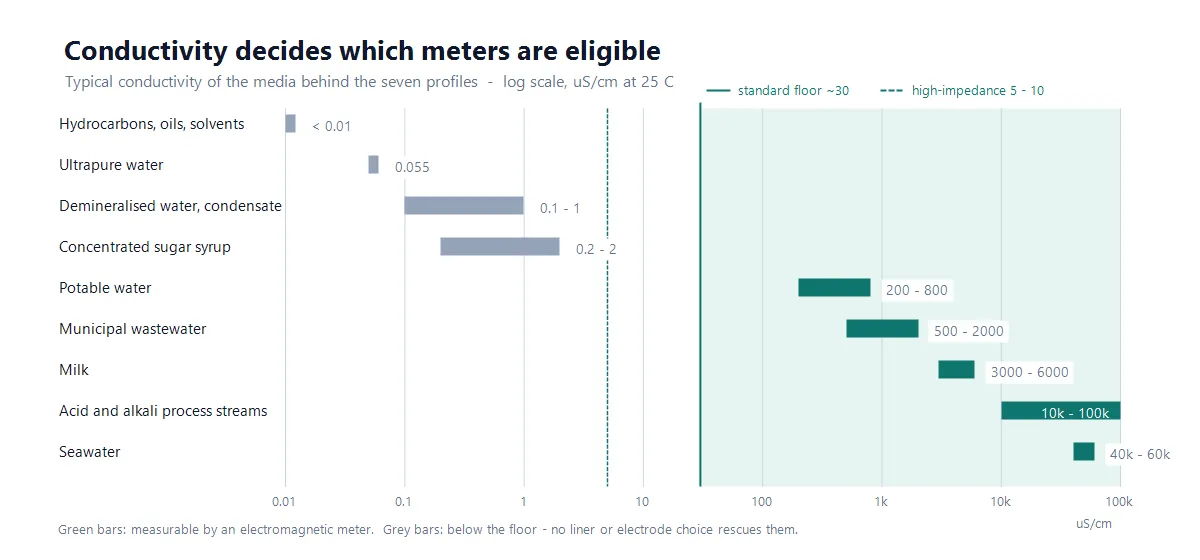
Conductivity spans six orders of magnitude across the seven industries. The measuring window, not the brand, rules most of them out.
The four variables sit on top of the normal selection steps, not instead of them. Process data, bore, liner, electrode, pressure protection, converter and grounding are worked through in the electromagnetic flowmeter selection guide; this article is about what the industry overrides once those steps are done.
One Material, Two Industries, Opposite Verdicts
This is the part that a generic selection table cannot tell you. Every material below is the right answer somewhere and the wrong answer somewhere else, and both places are common.
Material | Right in | Wrong in | Why it flips |
PTFE liner | Chemical, acid and alkali service, oxidisers | Mining slurry, pulp stock | Chemically inert but soft — abrasion removes it quickly. Also capped at 120 °C |
FEP (F46) liner | Food and dairy CIP circuits, hot chemical lines | Heavy slurry | Same chemical family as PTFE, usable to 180 °C, still not a wear material |
Hard rubber (CR) liner | Water, wastewater, mild chemical, −20 to 60 °C | Food, solvents, hot lines | Cheap, tough, and not cleanable to hygienic standards |
PU (polyurethane) liner | Slurry, sand, mineral processing | Strong acid or alkali | The best abrasion resistance in the range, the weakest chemical resistance |
Tungsten carbide electrode | Sand-bearing water, slurry, pulp filler | Acid service | Extremely hard, and a carbide — it corrodes where chemistry, not erosion, is the threat |
Hastelloy C electrode | Chlorides, oxidisers, bleach, seawater | Pure abrasion duty | Corrosion-resistant, not a wear part |
316L electrode | Potable water, wastewater, mild duty | Chlorides, acids | The default, and the first thing to pit in a salt line |
Read that table as a shortlist, not a specification. Two rows in it contradict the instinct of most buyers: the expensive liner (PTFE) is the wrong purchase in a mine, and the cheap electrode (316L) is the wrong purchase in a brine line.
Profile 1 — Water and Wastewater
This is the base case, and the scenario-by-scenario version — inlet sewage, return sludge, waste sludge, effluent — is covered in the wastewater flow measurement guide. What that guide does not cover is the two ends of the water spectrum, and both turn up in the same plant:
Very clean water is not automatically measurable. Reservoir and mountain water can sit at 30–80 µS/cm, which is at or below the floor of a standard converter. If the source is soft surface water rather than municipal supply, measure the conductivity before you specify anything.
Very dirty water is measurable but not durable. Screenings and grit at the inlet attack the electrode, not the liner. Tungsten carbide is the electrode to ask about when sand is present.
Profile 2 — Chemical and Petrochemical
Material compatibility for acids, alkalis and oxidisers is covered in the chemical media guide, which works through PTFE, FEP and PU liners against Hastelloy, titanium, tantalum and platinum electrodes. The gap in that article, and the most common reason a chemical line ends up with the wrong instrument, is the conductivity veto:
Organic solvents, and most hydrocarbon streams, are below the floor. Toluene, xylene, acetone and similar have conductivities several orders of magnitude under 1 µS/cm. No liner or electrode choice rescues them. They belong to a positive displacement or Coriolis meter.
Concentrated acids and caustics are usually excellent conductors. The problem there is corrosion, not signal — which is exactly what the material tables are for.
So in a chemical plant the first question is not "which liner" but "does this stream conduct". Ask it before the material discussion starts, or the material discussion is wasted.
Profile 3 — Food, Beverage and Dairy
Three things change here, and only one of them is about the product.
The cleaning cycle sets the temperature, not the process. A dairy line running at 4 °C is cleaned at 130–140 °C. A PTFE liner rated to 120 °C is therefore outside its limit twice a day, every day. This is the single most common specification error in hygienic service, and the fix is FEP (F46), rated to 180 °C.
The connection is part of the measurement. Hygienic service means tri-clamp or DIN connections, a surface finish typically specified at Ra ≤ 0.8 µm, no dead legs, and a body that drains. A meter that meets the accuracy specification but traps product in a pocket is a contamination risk with a flow reading attached. Ask for the 3-A or EHEDG documentation rather than a verbal assurance — the certificate is the deliverable.
Conductivity quietly disqualifies some products. Milk sits around 4–5 mS/cm and measures well. Concentrated sugar syrup, edible oils and alcohol streams do not — a 65 °Brix syrup can be below 1 µS/cm, and an oil is effectively an insulator. The same plant that measures milk perfectly will fail on the syrup line, and the failure will be blamed on the meter.
Electrode choice follows the product, not the industry: 316L for milk and most beverages, Hastelloy C where brine or salt is present, and no exposed threads anywhere in the flow path.
Profile 4 — Mining and Mineral Processing
In a mine the design driver is abrasion, and everything else is secondary. The configuration is consistent: PU liner, tungsten carbide electrode, and a body that can be re-lined rather than replaced.
The decision that actually determines cost is velocity, not bore. Abrasive wear rises steeply with velocity — doubling it multiplies wear several times over, which is why slurry lines are sized on a velocity band rather than on the meter's flow range. A commonly used band is 2–4 m/s; treat it as a starting point to confirm with the meter supplier for your solids size, concentration and shape, because a sharp sand and a rounded limestone behave differently at the same velocity.
That creates a real tension with normal sizing practice. Standard practice sizes down to stay in range and save money. In slurry service, sizing down raises velocity and shortens liner life, while sizing up drops velocity below the meter's low-flow limit and loses the reading at low production rates. The correct bore is the one that keeps velocity inside the band at normal flow, accepting that it may read poorly at the very bottom of turndown.
Two more things specific to slurry:
Grounding rings are not optional when the pipe is lined or the spool is isolated. Without them the reading drifts and nobody can explain why.
Tell the supplier if the solids are magnetic. Magnetite and other magnetic ores disturb the field pattern in a way that a standard calibration does not account for.
Profile 5 — Pulp and Paper
Stock is abrasive and it fouls. Fibre and fillers — clay, calcium carbonate, titanium dioxide — both wear the meter and coat the electrodes, and coating is the failure mode that looks like a mystery: the reading drifts down over weeks, then stabilises at a value that is wrong by a fixed percentage.
Configuration follows the duty rather than the mill: hard rubber or PU liner for stock lines, tungsten carbide where filler loading is high, Hastelloy C in the bleach plant where chlorine dioxide and hypochlorite are present. Titanium is the alternative in oxidising bleach service, but it is the wrong choice in reducing conditions.
Ask for a meter that reports electrode condition or empty-pipe status. On a stock line, the difference between "the meter is drifting" and "the electrode is coated" is worth more than a decimal place of accuracy.
Profile 6 — Power Generation and Desalination
Three duties, three different answers, and one trap.
Circulating cooling water is the easy case: large bore, hard rubber liner, 316L electrode, and a velocity check to keep erosion-corrosion away from the pipe wall. Cost per unit diameter matters more than any other specification here.
Demineralised water, condensate and boiler make-up are the trap. At 0.1–1 µS/cm these streams are an order of magnitude below the standard floor. An electromagnetic meter installed there will read zero, or noise, and no amount of grounding will fix it. Use a Coriolis or a transit-time ultrasonic meter. This is the most expensive wrong instrument in a power plant because it is usually discovered at commissioning.
Seawater and desalination feed conduct extremely well — around 50,000 µS/cm — and destroy the wrong materials quickly. Titanium or Hastelloy C electrodes, PTFE or hard rubber liner, and attention to the body material: 316L in a seawater line is a pitting experiment. In FGD limestone slurry the medium is both abrasive and corrosive, so it wants PU or hard rubber with tungsten carbide or Hastelloy, and it will still be a consumable.
Profile 7 — Marine and Shipboard
Shipboard service adds two requirements that land work rarely has: submersion and classification.
Bilge and ballast duties need IP68, because the meter may sit in water. The cable entry, not the body, is where that specification is usually lost.
Type approval may be contractual. If the yard or the owner requires a class society certificate, that is an order-code question to settle before the PO, not a document to request afterwards.
Grounding behaves differently on a steel hull. The pipe is bonded to the hull, which usually makes grounding easier — and makes stray currents a genuine risk. Check the bonding arrangement rather than assuming the meter's own grounding rings solve it.
Ballast water treatment systems add a flow signal that the treatment unit depends on, so the meter is often part of a certified arrangement rather than a standalone instrument. Confirm the interface with the BWMS supplier early.
The Specification Matrix
Industry | Typical medium | Liner | Electrode | What to check first |
Water and wastewater | Sewage, sludge, effluent | Hard rubber (CR) | 316L; tungsten carbide if sand | Conductivity of very clean water |
Chemical | Acids, alkalis, oxidisers | PTFE, FEP | Hastelloy C, titanium, tantalum | Does the stream conduct at all |
Food and dairy | Milk, beverage, syrup | FEP (F46) | 316L, Hastelloy C for brine | CIP temperature against liner limit |
Mining | Slurry, tailings | PU | Tungsten carbide | Velocity band, magnetic solids |
Pulp and paper | Stock, bleach liquor | Hard rubber, PU | Tungsten carbide, Hastelloy C | Fouling and cleaning interval |
Power and desalination | Cooling water, seawater, condensate | CR, PTFE | 316L, titanium, Hastelloy C | Condensate and demin water are not measurable |
Marine | Ballast, bilge, scrubber water | CR, PTFE | Titanium, Hastelloy C | IP rating and class approval |
Read the matrix as a starting shortlist. It cannot replace a conductivity measurement, a solids analysis or the mill's own standard, and in most cases one of those three will overrule a row in the table.
Where an Electromagnetic Meter Is the Wrong Answer
Medium | Why it fails | What to use instead |
Hydrocarbons, solvents, edible oil | Effectively non-conductive | Positive displacement (oval gear), Coriolis, turbine |
Demineralised or ultrapure water | Below the conductivity floor | Coriolis, transit-time ultrasonic |
Gas and steam | Not a liquid, no conductive path | Vortex, thermal mass, differential pressure |
Heavy slurry with large particles | Signal attenuates and the liner erodes | Doppler ultrasonic, Coriolis, or a wear-designed EM with a maintenance budget |
Dosing at millilitre rates | Below the low-flow limit of any full-bore meter | Coriolis or a gear meter |
Above the liner temperature limit | The liner, not the electronics, is the limit | Ceramic-lined or non-contact technology |
What to Send Us
A quotation that is worth comparing needs seven numbers, and most RFQs arrive with three:
Medium, and its conductivity in µS/cm — measured, not assumed.
Line size and material, plus the flow range in m³/h at normal and minimum.
Temperature and pressure, including the cleaning cycle if there is one.
Solids content and particle size, if any.
Liner and electrode preference, or the chemical list if you would rather we propose.
Hygiene, hazardous area or classification requirement.
Whether the output feeds a control system, a totaliser or a billing record.
The seventh is not a detail. A meter feeding a batch controller and a meter feeding a report have different requirements for response time, low-flow cut-off and diagnostics, and the difference is decided before the order, not after.
FAQ
Does an electromagnetic flowmeter work for every liquid? No. It needs a conductive liquid — roughly 30 µS/cm and up on a standard converter, and 5–10 µS/cm on high-impedance models. Hydrocarbons, most solvents, edible oils, demineralised water and concentrated sugar solutions fall below that, and no configuration change fixes it.
Can I use one meter model across a whole plant? The body and converter, often yes. The liner and electrode, rarely. A water liner in a slurry line wears out, a PTFE liner in a CIP circuit exceeds its temperature, and a 316L electrode in brine pits. Standardising on the body is reasonable; standardising on the wetted materials is how plants end up replacing meters.
Why does my meter read low after a few months? On abrasive or fouling duties, the two usual causes are liner wear (which changes the bore) and electrode coating (which attenuates the signal). Both look like calibration drift. Check the electrode first, because it is the cheaper fix, then inspect the liner. The troubleshooting guide works through the converter codes and the field checks that separate the two.
Do I need grounding rings? If the pipe is lined, isolated, or made of plastic, yes. In a metal pipe with a good bond to earth the meter's own grounding may be enough. Marine and slurry installations are where the absence of rings shows up fastest, as an unstable reading rather than a zero.
What surface finish do I need for food service? Ra ≤ 0.8 µm is the usual hygienic requirement, together with a drainable body, no dead legs and a tri-clamp or DIN connection. The finish is only half the deliverable — ask for the 3-A or EHEDG documentation as well.
Can an electromagnetic meter measure seawater? Yes, and it measures it very well, because seawater conducts at around 50,000 µS/cm. The difficulty is material survival, not signal: titanium or Hastelloy C electrodes, a PTFE or hard rubber liner, and a body specification that acknowledges chlorides.
Next Step
If you have the seven numbers above, send them and we will come back with a configuration rather than a catalogue page. If you have only the line size and the medium, send those — the conductivity and the solids are the two questions we will ask first, because they decide whether the rest of the conversation is about materials or about a different instrument.
The liner and electrode combinations above are the ones we build into our electromagnetic flow meters, and the fastest route to an answer is to send the duty rather than to read another datasheet.
Ethan Liu
Ethan Liu is JUJEA's technical content specialist, translating complex sensor integration and industrial automation concepts into practical insights for engineers, system integrators, procurement professionals, and decision-makers worldwide.


 한국어
 français
 Deutsch
 Español
 italiano
 русский
 português
 العربية
 tiếng việt
 čeština